A new survey of 1,000 U.S. full-time workers finds that 86% now use AI tools for work. What they're doing with those tools, and what they're concealing, tells a very different story than the one employers are seeing.
Study highlights:
- 1 in 7 AI-using workers landed their current job by having AI whisper answers during a live video interview.
- More than 1 in 4 AI users have skills listed on their resume or LinkedIn that they can only perform with significant AI assistance.
- Nearly 4 in 10 have submitted work to their employer that was fully or almost fully generated by AI.
- 1 in 6 has received a promotion based at least partly on AI-created output.
- Nearly 1 in 4 AI users is effectively hiding their AI use from their manager.
- 1 in 13 has directly lied to their manager when asked about it.
- Nearly 1 in 5 have noticed their professional skills getting worse since starting to use AI.
- 47% have used AI to finish work early and spend the remaining on-clock hours on personal activities.
1 in 7 Workers Got Their Current Job With AI Coaching Them in Real Time
The job interview has become the first place AI fraud is showing up - and employers almost certainly don't know it.
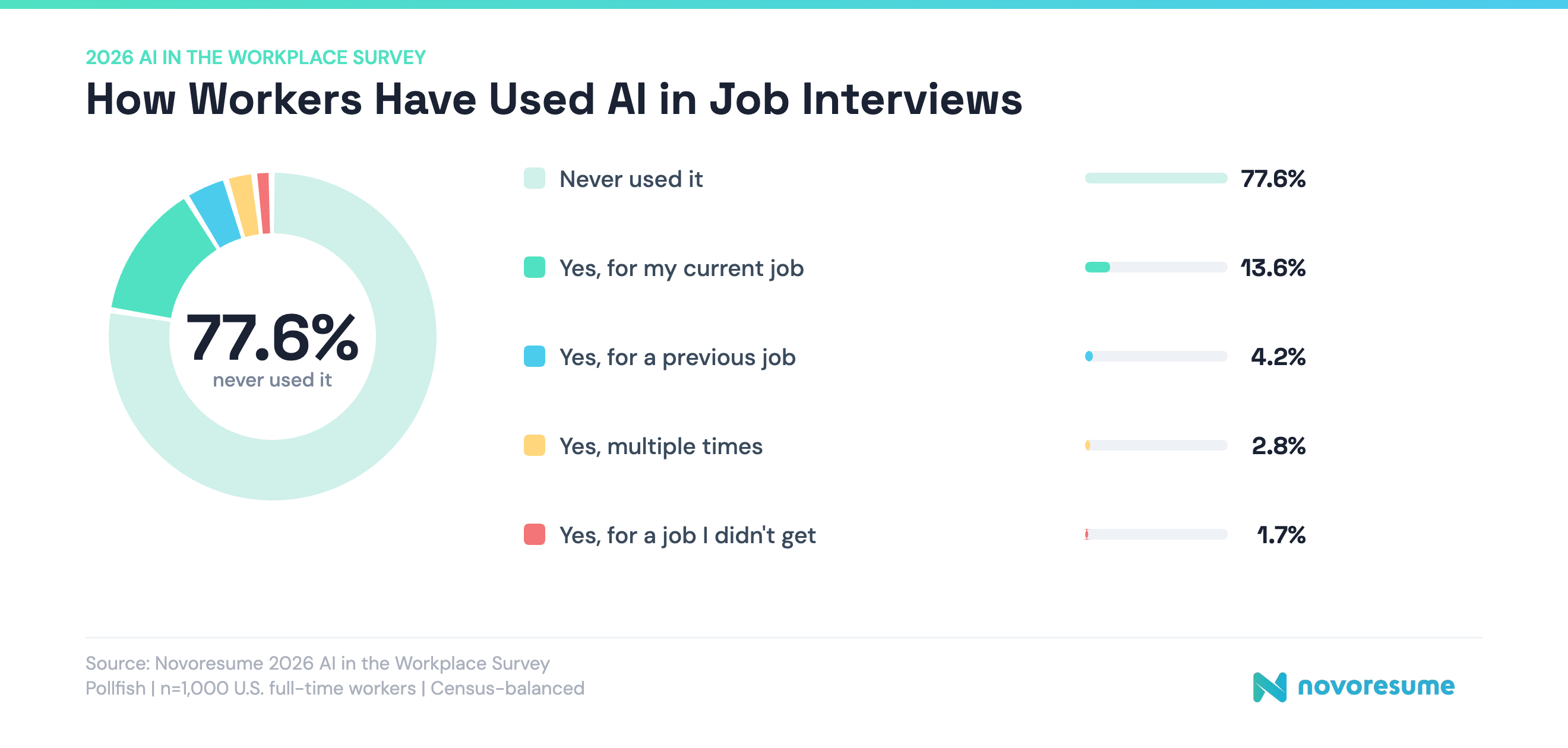
Of the 858 AI-using workers surveyed, 22.4% admit to using AI in real time to help them answer questions during a live video job interview - with AI whispering answers while they're on camera.
Of those, 13.6% used this technique to land the job they're in right now.
That means roughly 1 in 7 workers currently at their desks got there with AI coaching them through the interview. Their employers hired them, believing they were seeing unassisted performance. In a meaningful share of cases, they weren't.
Younger workers are doing this most, but the generational spread is narrower than expected. Gen Z workers lead at 27.9%, with Millennials close behind at 26.9%. Gen X comes in at 16.2%. The most counterintuitive finding: Boomers (22.6%) outpace Gen X, suggesting this behavior isn't purely a function of tech comfort.
Men are significantly more likely to have used AI interview assistance than women: 26.4% vs. 17.5%.
"The job interview used to be the last checkpoint employers had against resume inflation," says Andrei Kurtuy, career expert at Novoresume.com. "AI whispering doesn't just help candidates sound more prepared - it lets someone perform at a level they may not be able to sustain once they're hired. That gap eventually shows up on the job."
1 in 4 AI Users Have Resume Skills They Can't Actually Do Without AI
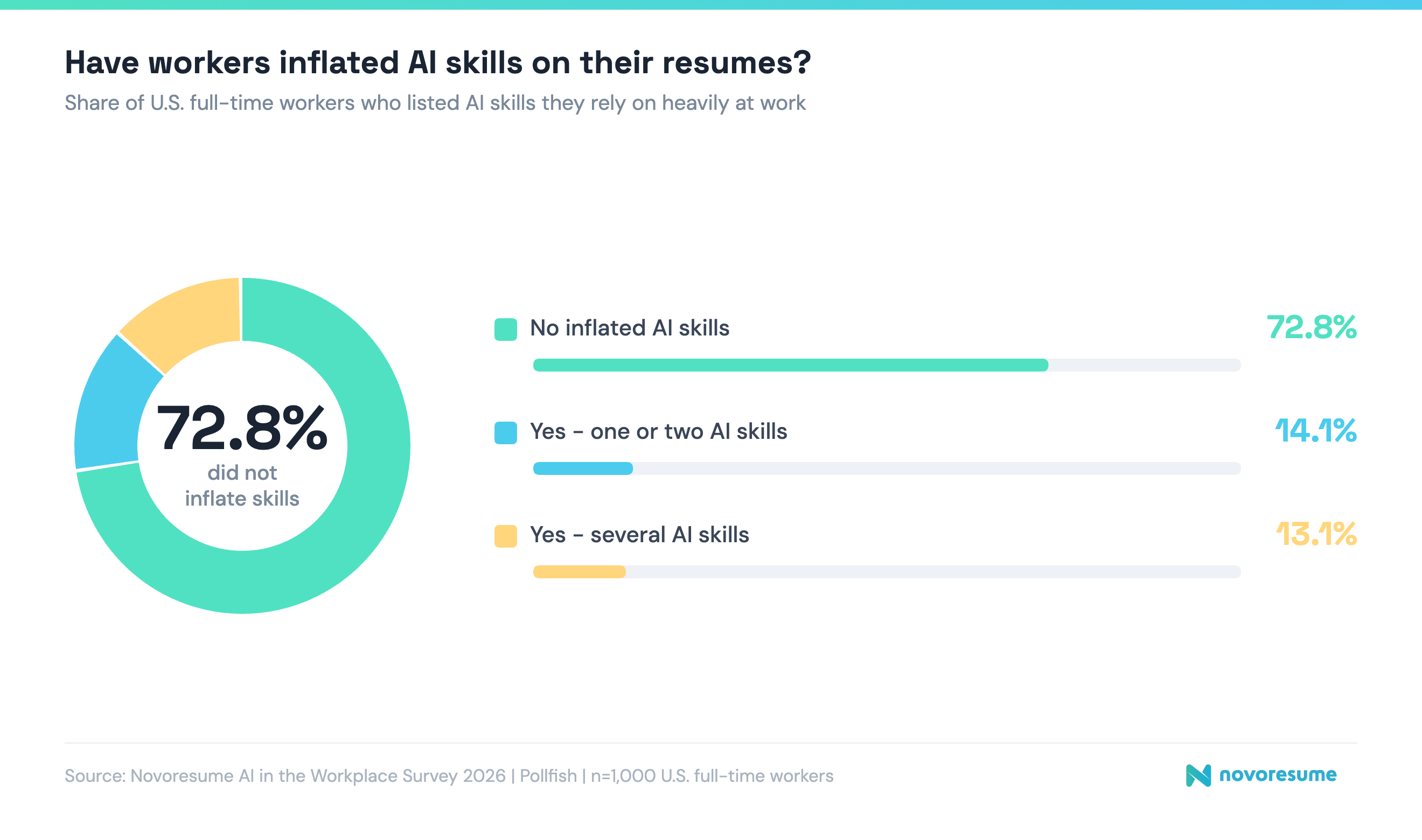
27.2% of AI-using workers have skills listed on their resume or LinkedIn profile that they can only perform with significant AI assistance. And for 13.1% of AI users, this applies to several skills, not just one.
The generational breakdown reveals a sharp divide. More than a third of Gen Z workers (36.8%) and Millennials (35.0%) have AI-dependent skills on their profiles. That figure drops to 18.5% for Gen X and 15.1% for Boomers.
The gender gap is again notable: 33.5% of male AI users have inflated their profiles this way, compared to 19.5% of female AI users.
This is a different kind of misrepresentation than padding a resume with vague buzzwords. These are skills workers list as real competencies, but that they can only demonstrate with AI actively running alongside them. If the tool disappeared, so would a portion of their stated qualifications.
"There's a distinction between using AI as a productivity tool and using it as a capability prosthetic," Andrei says. "The latter is when you're listing skills you'd lose if the tool went away. Hiring managers have no reliable way to test for this yet, which is part of what makes it so common."
Nearly 4 in 10 Have Submitted Work That Was Fully Generated by AI
Resume inflation gets workers in the door. What happens next follows a similar pattern.
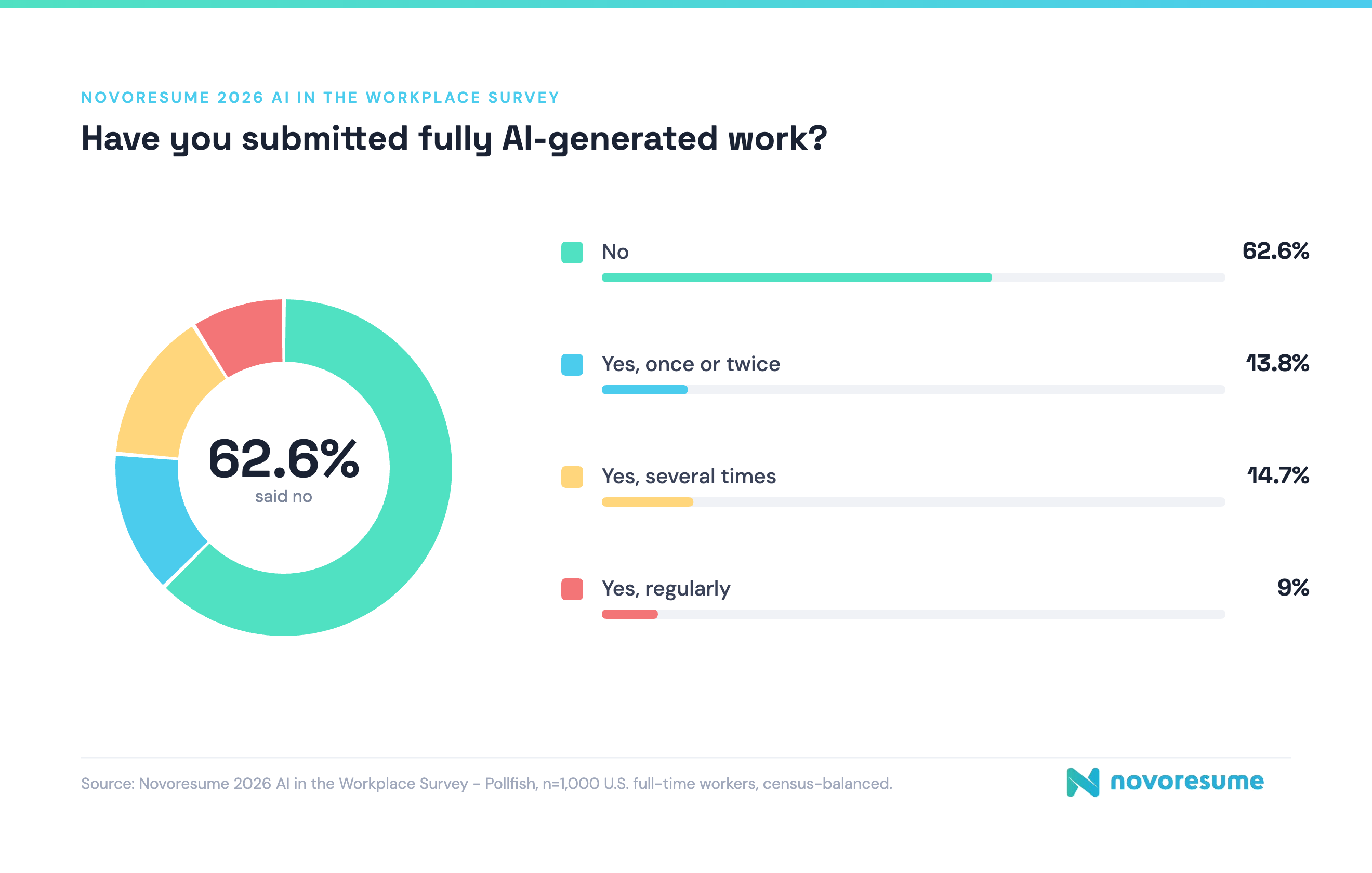
37.4% of AI-using workers have submitted work to their employer that was fully or almost fully created by AI, with minimal editing from them. 9% do this regularly. Another 14.7% have done it several times.
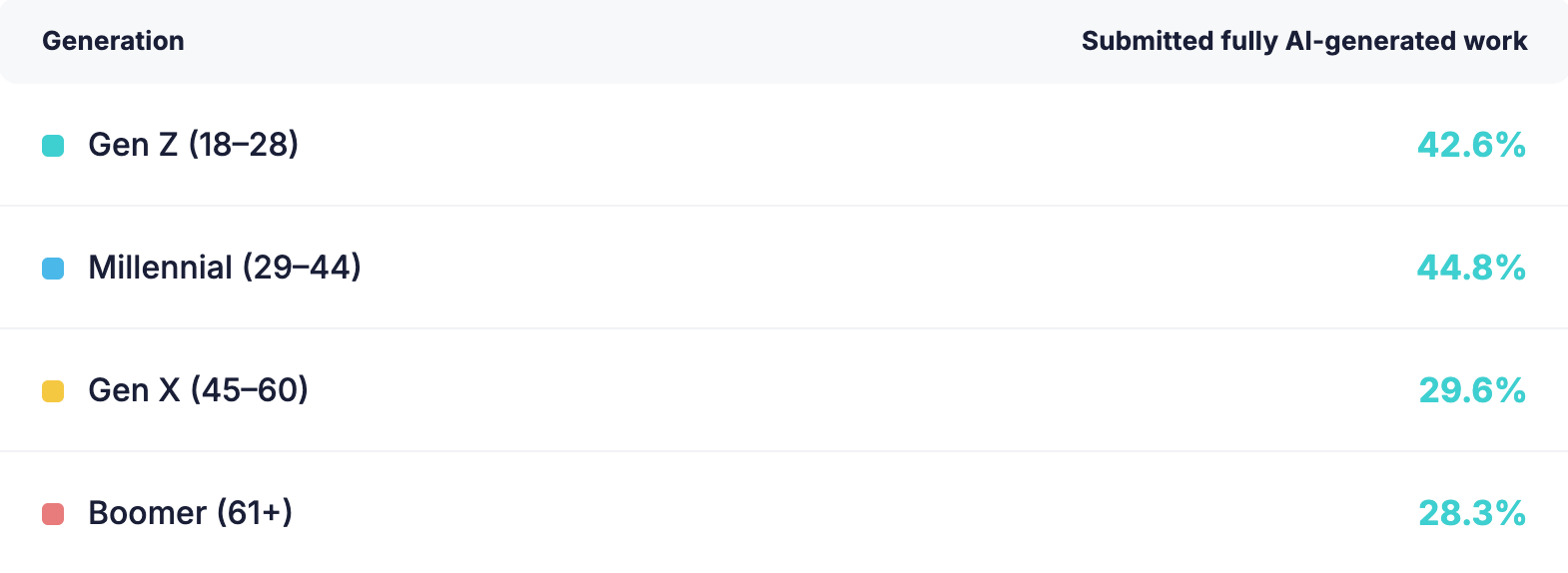
Millennials and Gen Z are the heaviest offenders: 44.8% of Millennial AI users and 42.6% of Gen Z users have submitted fully AI-generated work. Gen X (29.6%) and Boomers (28.3%) are lower, but still represent more than 1 in 4.
By gender: 44.6% of male AI users have done this, compared to 28.8% of female AI users - a 15-point gap.
The volume here matters. This isn't a fringe behavior or a one-time experiment. For a significant slice of the workforce, submitting AI-generated work as their own has become routine. The output gets delivered, the manager approves it, and no one asks questions.
"The question employers need to be asking isn't whether their team uses AI - it's whether the work they're reviewing actually reflects the judgment and capability of the person submitting it," Andrei tells us. "In many cases, the answer is increasingly no."
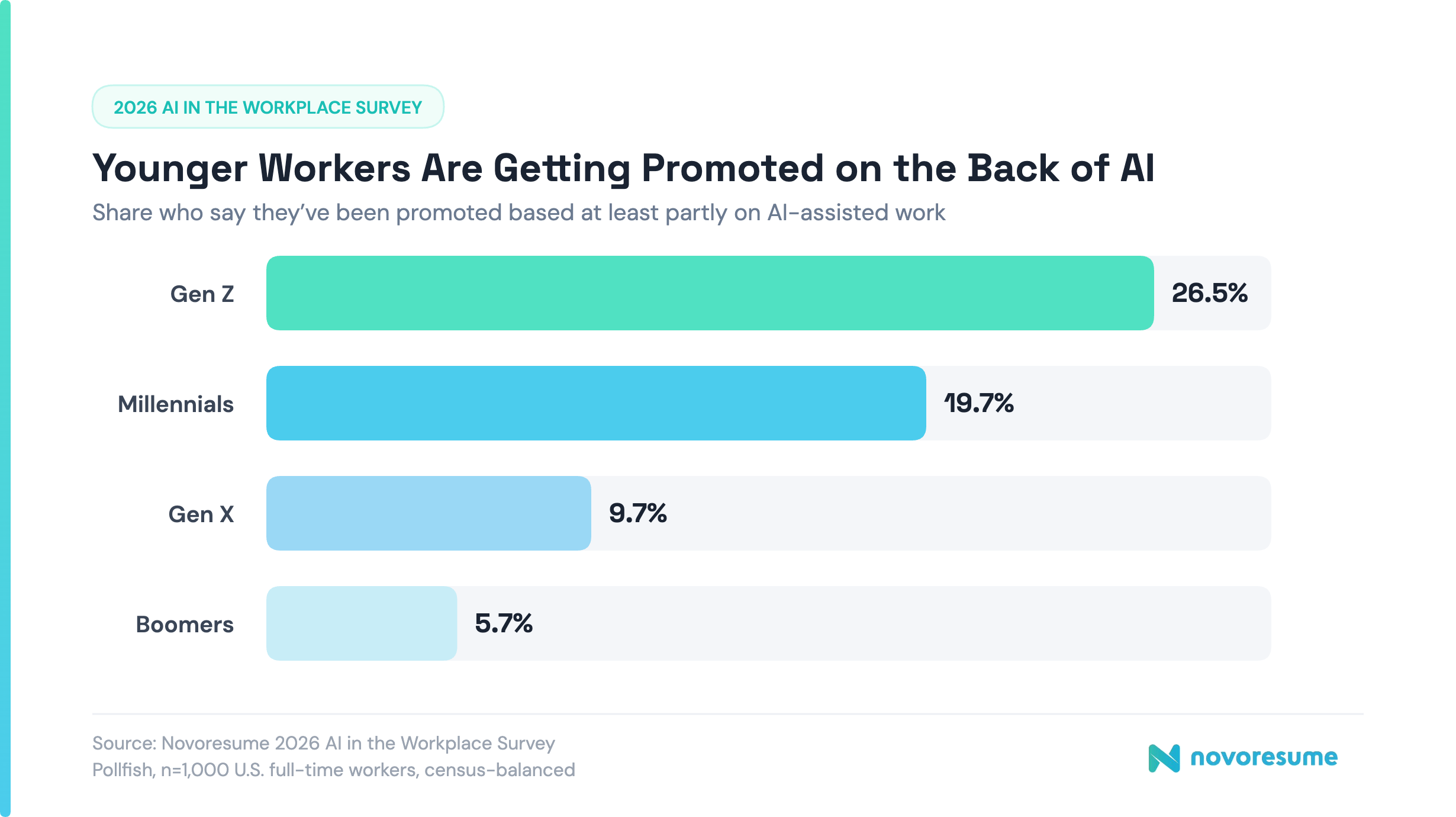
The consequences of submitted AI work are compounding. 15.3% of AI-using workers have received a promotion based at least partly on work AI helped create.
Among younger workers, this figure is significantly higher. 26.5% of Gen Z AI users have earned a promotion this way. For Millennials, it's 19.7%. Gen X sits at 9.7%, and Boomers at 5.7%.
The career implications are real. Workers are being evaluated, rewarded, and moved up based on output that doesn't fully reflect their underlying abilities. Performance reviews are being shaped by AI capabilities that managers may not even know exist.
12.4% of AI-using workers say they haven't been promoted since starting to use AI - meaning the 15.3% figure represents those who have actually had the opportunity for this dynamic to play out. As AI use matures in the workplace, that number is likely to rise.
"A promotion is supposed to signal that someone is ready for the next level of responsibility," Andrei noticed how every aspect of work has shifted because of AI. "When the output that drove that promotion was largely AI-generated, the company has made a bet on a capability that may not actually be there."
Nearly 1 in 4 Workers Is Hiding Their AI Use From Their Manager
Even among workers who aren't doing anything explicitly deceptive with AI, transparency is far from the norm.
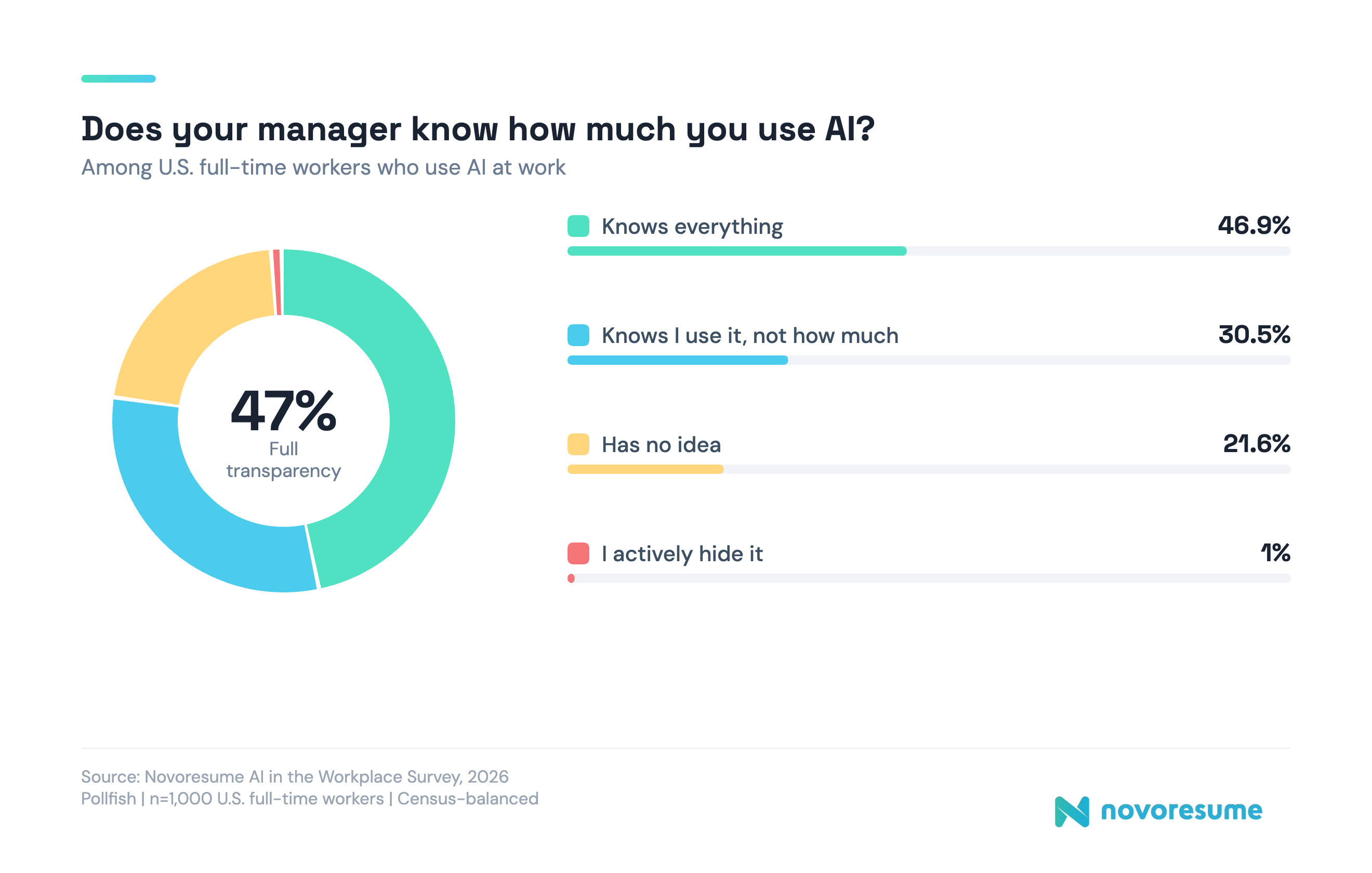
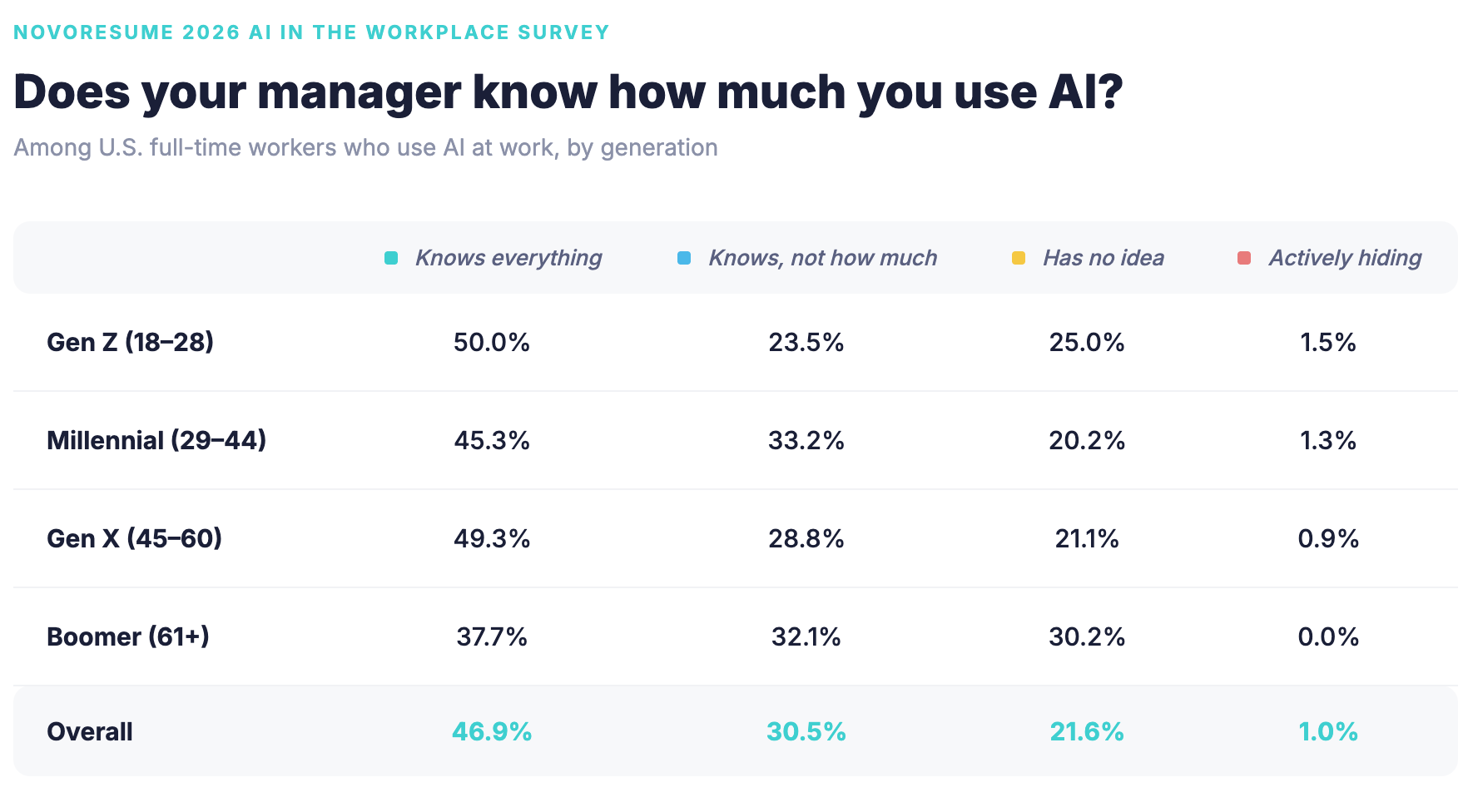
21.6% of AI users say their manager has no idea how much AI they use. Another 1% are actively hiding it. Combined, that's 22.6% of AI users whose managers are operating without an accurate picture of how work is actually getting done.
An additional 30.5% say their manager knows they use AI but doesn't know how much. Only 46.9%, fewer than half of AI-using workers, say their manager knows everything.
7.6% have gone a step further and directly lied to their manager when asked about AI use. 17.4% say they've never even been asked.
Lying rates vary significantly by generation: Millennials are most likely to have lied (10.9%), followed by Gen Z (8.8%), Boomers (5.7%), and Gen X (4.0%). The transparency picture by generation tells its own story.
Boomers are the most opaque overall - just 37.7% say their manager knows everything, the lowest of any generation, and 30.2% say their manager has no idea. Notably, zero Boomers say they're actively hiding it, so their opacity tends to be more passive rather than deliberate. Gen Z, by contrast, has the highest "manager knows everything" rate at 50%.
"Most organizations don't have an AI disclosure policy, and many managers haven't established any expectations around it," Andrei explains. "That ambiguity creates the perfect cover. Workers use it to justify the behavior that benefits them."
Nearly 1 in 5 Workers Have Noticed Their Skills Getting Rusty
The longer-term cost of heavy reliance on AI is beginning to show up in how workers assess themselves.
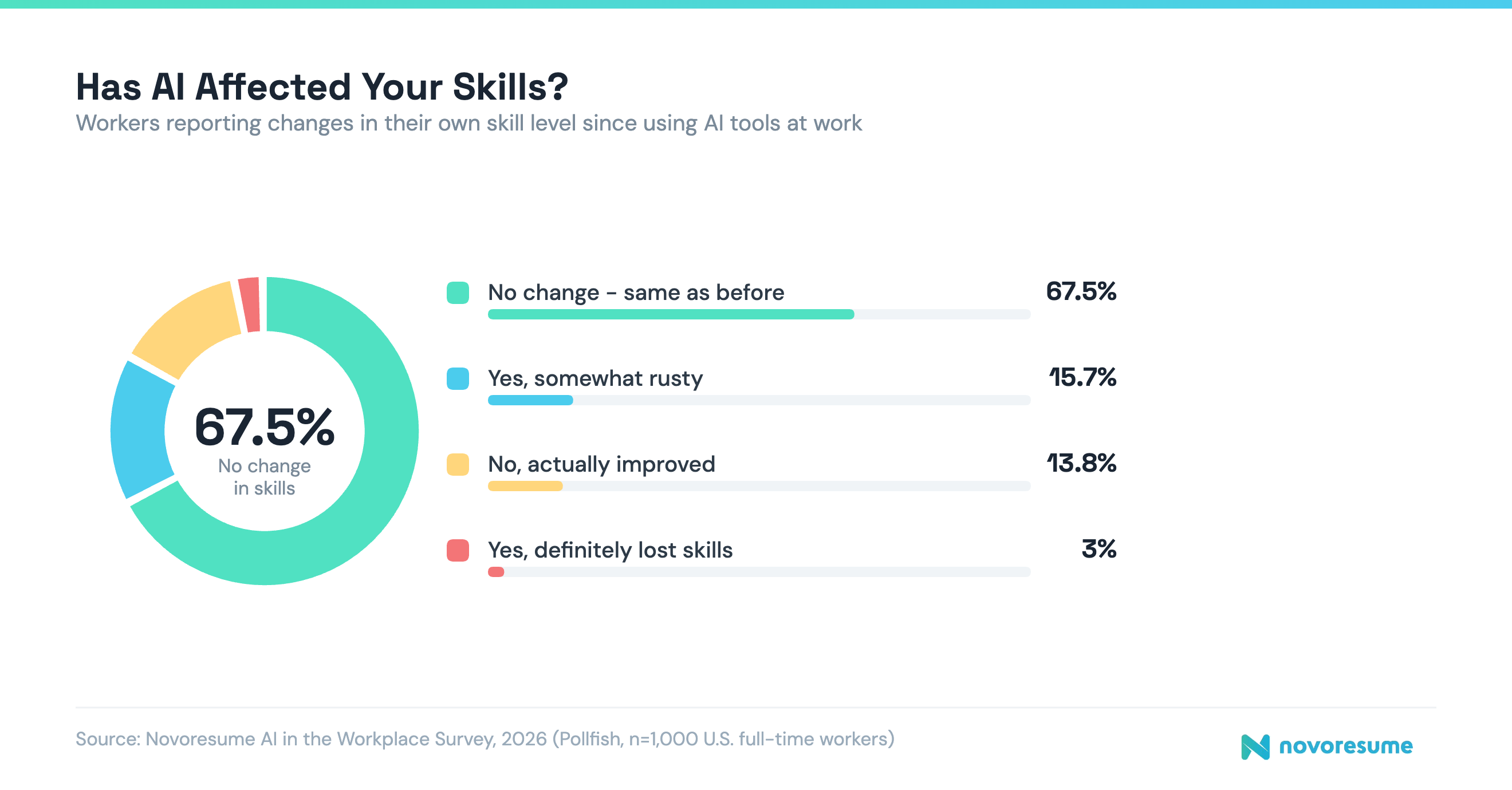
18.8% of AI-using workers say they've noticed their professional skills getting worse or "rusty" since starting to use AI regularly. 3% say they've definitely lost skills they used to have.
Skill erosion is highest among Gen Z (23.5%), Boomers (22.6%), and Millennials (21.5%). Gen X reports the lowest rate at 14.2%.
The counterintuitive flip side: 13.8% of AI users say their skills have actually improved since using AI. That's a legitimate finding since AI can function as a learning tool for some workers even as it acts as a crutch for others. The net picture, though, is that more people are losing ground than gaining it.
"Skill atrophy from AI isn't a theory - workers are already reporting it," with Novoresume.com, Andrei’s helped more than his fair share of job seekers and seen it first-hand. "The workers who fare best in the long-term are those using AI to understand things faster, not to avoid understanding them entirely."
The Heaviest AI Users Are Doing Everything More
When you look specifically at workers who use AI multiple times a day, who are 42.9% of all AI users, the behavioral patterns intensify sharply.
Of these power users, 66.6% have used AI to finish their work early and spend the remaining on-clock hours on personal activities. That compares to 47% across AI users overall. The more embedded AI becomes in how someone works, the more it appears to reshape their relationship with the workday itself.
The Time Theft Findings
The survey also found that 47% of AI-using workers have used AI to finish their tasks faster and then spent the remaining on-clock hours on personal activities, with their employer completely unaware. Millennials lead at 54.7%, followed by Gen Z at 48.5%, Gen X at 40.2%, and Boomers at 35.8%. Men (54.8%) are significantly more likely to do this than women (37.8%).
This finding was explored in depth in our previous report. What's notable in the context of this broader audit is that it's not the most common AI-related behavior. Submitting fully AI-generated work (37.4%) and resume inflation (27.2%) represent behaviors with more structural implications for hiring, performance management, and career progression.
Non-Users Think They Have the Advantage and Plan to Stay That Way
The 142 workers who don't use AI for work have a notably different read on the situation than the headlines suggest.
94.4% of non-users feel no disadvantage compared to their AI-using coworkers. 21.8% say they actually think they have an advantage over coworkers who rely on AI. That’s a striking position given how dominant the "AI is inevitable" narrative has become.
49.3% say they definitely won't start using AI tools in the next year. Only 4.2% say they probably or definitely will.
Their skepticism extends to their AI-using peers: 27.5% of non-users believe coworkers who use AI are being dishonest about their capabilities. That figure is worth sitting with. The people in the office who aren't using AI are watching their coworkers and, for more than 1 in 4, concluding that something doesn't add up.
The top reasons non-users give for staying out: preferring to do things themselves (33.8%), not trusting AI output (31.0%), not thinking AI would help with their work (28.9%), privacy and security concerns (25.4%), and company restrictions (23.9%).
Workers Feel Fine About All of It
Across all of these behaviors, guilt is not a common response.
58.5% of AI users say they feel no guilt about their AI use - it's just a tool. 30.2% say they feel smart for being more efficient. 29.4% say they feel like everyone is doing it. 23.7% feel proud for embracing new technology.
Only 10.1% feel like they're cheating. 9.3% are anxious that AI will replace them. 5.4% feel guilty about how much AI does for them. 4.9% feel like an impostor.
74.2% are not worried about becoming too dependent on AI. 57.9% believe their job is completely safe from AI. Only 4% say they'd struggle significantly or couldn't do their job at all if AI disappeared tomorrow - meaning for the vast majority, the tool is something they've chosen to pick up, not a crutch they feel trapped by.
The collective lack of guilt is, in some ways, the most significant finding in the dataset. The behaviors documented above - interview fraud, resume inflation, submitting AI-created work, suppressing AI disclosure - aren't things workers are agonizing over. They're things workers have largely made their peace with.
"The guilt phase seems to be over," Andrei concludes. "When fewer than 1 in 10 workers feel like they're cheating, and 6 in 10 feel no guilt at all, you're not looking at a workforce wrestling with an ethical question. They’ve already answered it."
The Gender Gap Runs Through Everything
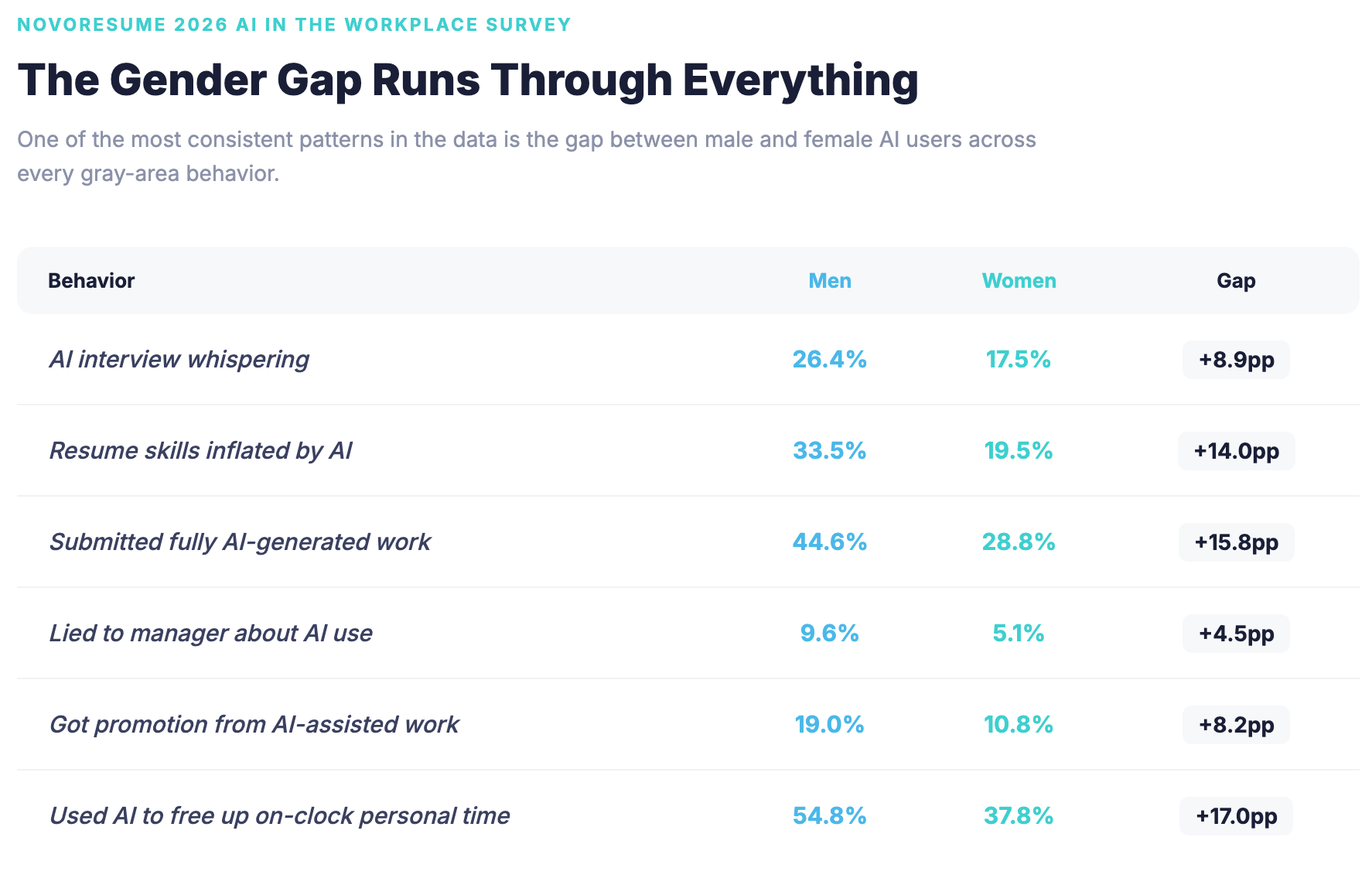
One of the most consistent patterns in the data is the gap between male and female AI users across every gray-area behavior.
The gap is consistent, large, and runs in the same direction across every metric. Male workers are more likely to use AI deceptively, more likely to submit AI-generated work, more likely to lie about it, and more likely to have been rewarded for it. The 15-17 point gaps on submitted AI work and time reclamation are not marginal.
Whether this reflects different risk tolerance, different workplace contexts, or different relationships with workplace norms is a question this survey can't fully answer. What the data can say clearly is that the gender split in AI-enabled workplace behavior is one of the most pronounced patterns in the dataset.
Methodology
This survey was conducted in February 2026 via Pollfish. A total of 1,000 U.S. full-time workers were surveyed. The sample was census-balanced for U.S. regions. Of the 1,000 respondents, 858 (85.8%) reported using AI tools for work tasks at least rarely and were asked the full set of behavioral questions. The remaining 142 respondents who do not use AI were asked a separate set of questions about their attitudes toward AI in the workplace.
Generational definitions used: Gen Z (ages 18-28), Millennials (29-44), Gen X (45-60), Boomers (61+). Gender data reflects the 528 male and 472 female respondents in the total sample.


























 Add Novorésumé as a preferred source on Google