First Job Resume: How to Write One With No Experience (2026 Guide)

Updated on 04/14/2026

Your first job resume has one job: convince a stranger you're worth interviewing before you've done the work that normally proves it. That sounds hard, but the structure is actually simple. Lead with your strongest asset (usually education or a specific skill), replace the missing work experience section with internships, projects, or volunteer work, and keep the whole thing to one page.
In our survey of 203 HR professionals, 74% said they skim a resume in 20 seconds or less, and 82% use an applicant tracking system to screen resumes before a human reads a word. That means your first resume needs to pass two filters: the ATS and the 20-second human scan. This guide shows you how to build one that does both, whether you're a 16-year-old applying for your first part-time job or a recent grad chasing your first full-time role.
Here's what's inside:
- How to pick the right format (and why reverse-chronological wins)
- What to put in each section when you have no experience
- Real first job resume examples for teens, students, and grads
- How to pass ATS and AI screening filters
- Common mistakes and a full FAQ
What Makes a First Job Resume Work in 2026
A first job resume plays by different rules than a regular resume. You're selling potential, not track record, and you have roughly 20 seconds to prove it before the recruiter moves on.
Based on our survey of 203 HR professionals and 1,000 US workers, here's what actually matters:
- 74% of recruiters skim a resume in 20 seconds or less. Your top third is doing most of the work. For a first job resume, that's your summary, contact info, and education.
- 82% use an ATS to screen resumes before a human sees them. Graphics, text inside images, and non-standard headings get filtered out. Every Novorésumé template is built to pass ATS parsing.
- More than half of workers in our AI study believe AI now plays a role in resume review. That matters because AI screeners weight keyword matching and structure even more heavily than traditional ATS systems.
The takeaway: use reverse-chronological format, lead with your strongest asset, mirror keywords from the job description, and cut anything that doesn't support the role.
#1. Pick the Right First Job Resume Format and Template
Three resume formats exist, but only one makes sense for a first job resume.
- Reverse-chronological. Lists education and any experience with the most recent first. This is what 82% of ATS systems are built to parse, and what recruiters expect by default.
- Functional. Focuses on skills over timeline. Sometimes pushed for career changers, but most ATS systems struggle with it and recruiters tend to assume you're hiding something.
- Combination (hybrid). Mixes both. Useful for career changers with a mix of relevant and unrelated experience, but overkill for a first resume.
For 99% of first-time job seekers, use reverse-chronological. It's what recruiters expect, it passes ATS, and it keeps the page clean.
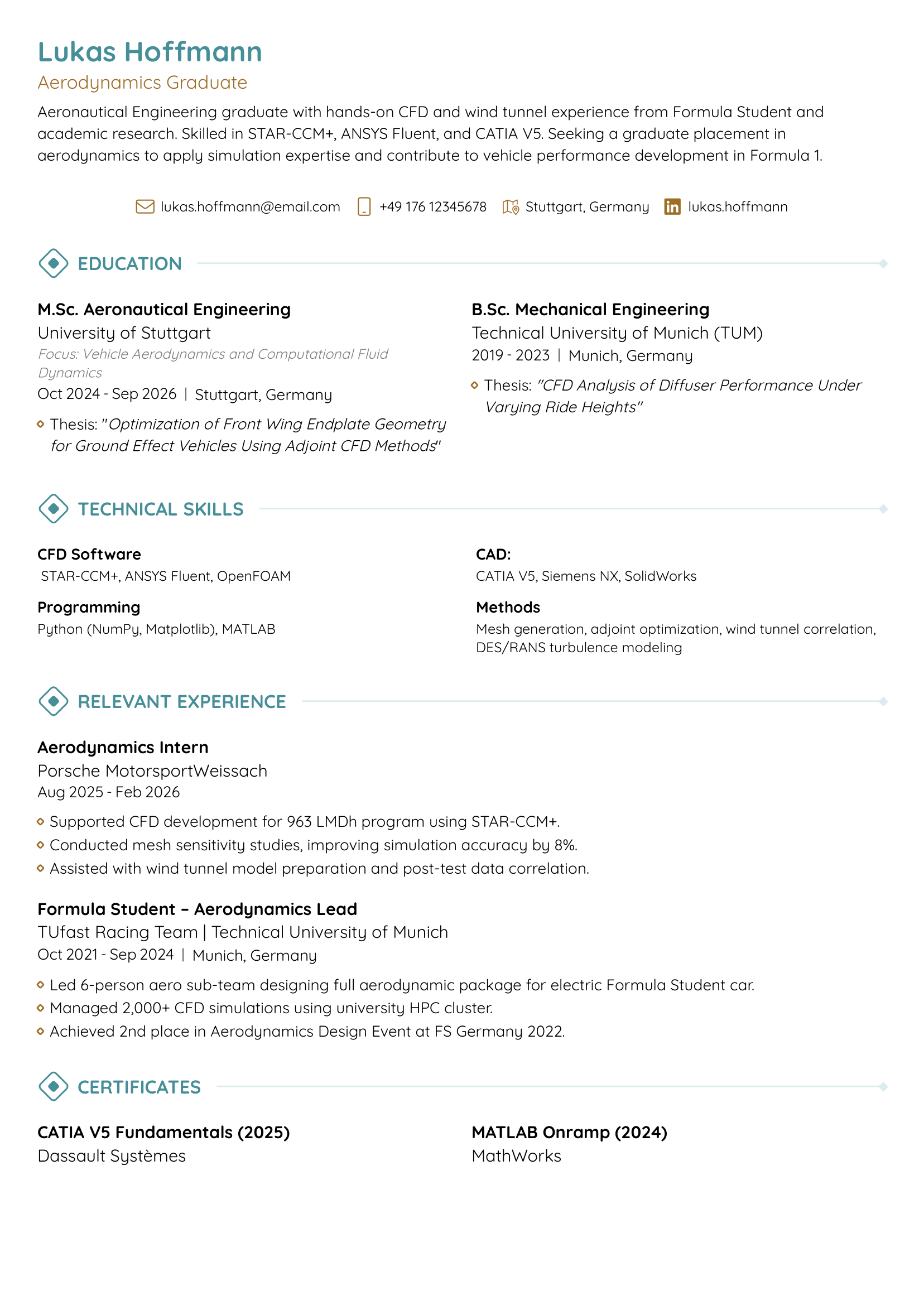
A reverse-chronological resume looks as follows:
A few layout rules that help with both recruiters and ATS:
- Use a two-column layout to fit more on one page
- Pick a standard font (such as the ones in Novoresume's editor)
- Use bullets, not paragraphs, to describe your experience
- Keep it to one page, two pages is not needed for a first job resume
#2. Write Down Your Contact Information (Correctly)
Contact information goes at the top of every resume. For a first job resume, include:
- First and last name
- Phone number
- Professional email address (firstname.lastname@gmail.com format, not hotshot999@hotmail.com)
- City and state (full address isn't needed)
- LinkedIn URL
Optional extras if they're relevant to the role:
- GitHub (for tech roles)
- Portfolio website (for design, writing, or creative roles)
- Relevant social accounts (Quora for writing, Behance for design, etc.)
Double-check that your phone number works, your email is current, and every link actually loads. Dead links on a first resume are one of the fastest ways to get filtered out.
#3. Write a Resume Summary (Not an Objective)
Resume objectives (for example, "Seeking an opportunity to grow and learn in a dynamic work environment") used to be standard. They're now the fastest way to signal that your resume is a template from 2012. Replace it with a resume summary.
A resume summary is two or three sentences at the top of your resume that tells the recruiter who you are, what you bring, and what role you want. It's the first thing they read, and with 74% of recruiters spending under 20 seconds on a first scan, it's the highest-leverage sentence on your whole resume.
A good first job resume summary includes:
- Your current stage (high school junior, CS sophomore, recent marketing grad)
- One or two specific skills or achievements tied to the role
- The role or company you're applying to
Summary Examples for First Job Resume
Recent graduate: Recent Communications graduate with practical experience coordinating cross-functional university projects and writing for a 12,000 reader student publication. Applying for the Secretary role at XYZ Inc. to bring strong organization, writing, and multitasking skills to a fast-paced team.High school student: High school junior with 2.5 years of volunteer customer service experience at the local community center and strong written and verbal communication skills. Applying for a part-time Barista role at Blue Bottle Coffee to build on a track record of reliability and customer focus.
#4. List Your Education (In Detail)
For starters, you should know how to list your education entries correctly in the following format:
- Program Name e.g.: B.A. in Information Systems
- University Name e.g.: University of Chicago
- Years Attended e.g.: 07/2023 - 05/2026
- GPA (only if really high)
- Honors (If applicable) e.g. Cum Laude
Exchange Program (If applicable) e.g. Exchange program in Berlin, Germany
Apart from your skills, your education is the biggest selling point in your first job resume.
Write down your GPA (if it’s something impressive), emphasize your honors, and most importantly, highlight your academic achievements by describing them in detail.
What you can also do is list specific courses that you have taken that are relevant to the position you are applying for.
If you're still in high school, list your school, expected graduation date, and three or four relevant subjects or achievements. GPA goes in only if it's 3.5 or above on a 4.0 scale (or the equivalent in your country's system). Honors, AP classes, student government roles, and competitive team placements all belong here.
Here’s an example of what an entry on the education section should look like:
Example:
B.A. in English Literature (Cum Laude)Boston University07/2022 - 05/2026- GPA: 3.9
- Courses: Advanced Topics in Literature: Shakespeare’s Work
- Clubs: Boston University Drama Club
- Exchange program in London, UK
#5. Instead of Work Experience, Focus On This
With no work experience to list, three sections replace the Work Experience block on your first job resume: internships, extracurricular activities, and projects. Together, they can fill the entire middle of the page.
In our HR survey, recruiters consistently ranked "demonstrated initiative outside the classroom" as a stronger signal than GPA alone for entry-level hires. A 3.5 GPA with evidence of leadership beats a 4.0 GPA with nothing else to show.
The recruiter will be looking for other experiences that enrich your profile, like:
- Internships
- Extracurricular Activities
- Projects
When talking about these experiences, format them just like you’d format your work experience.
For Example:
Business Analyst InternshipAAA CompanyMilan, Italy05/2025 - 12/2025- Ran weekly and monthly analysis on diverse areas of the business
- Created insightful reports of the analysis to present to managers and teams
- Defined strategic KPIs, in order to monitor the efficiency of commercial operations
When possible, try to focus on listing your achievements and not your responsibilities. This will help you stand out from the rest of the applicants.
More often than not, an applicant with extracurricular activities and an average GPA will impress the recruiter much more than a 4.0 GPA student with nothing else to show. When listing your extracurricular activities, each entry should have the following format:
Example:
Moot Court Club MemberBoston University2023 - 2026- Participated for two years in a row at the Philip C. Jessup International Law Moot Court Competition, making it to the finals in 2019
- Researched and prepared written pleadings, called memorials addressing timely issues of public international law
- Helped train the new club members in topics of international law
Finally, you can also list independent projects, if you have any. Think, something you did on the side just for yourself. This can be a personal project, small business or startup, side-gig, blog, etc.
You can format such experiences as follows:
Amy’s Book Club Blog2024 - Present- Created my own book club website for reviewing and discussing the latest books.
- Curated a monthly book calendar for my followers to follow, combining trending, relevant, and classic books.
- Created over 40 book review articles.
- On average, received 2000 visitors per month to the blog.
#6. Highlight Your Skills
Your skills section has two types of skills: hard skills and soft skills. For a first job resume, lean heavily on hard skills.
- Hard skills are specific, verifiable, and tied to the job (Adobe Illustrator, Excel, Python, Spanish fluency). A recruiter can test these.
- Soft skills are personality and working-style traits (teamwork, critical thinking, leadership). A recruiter can't verify these from a resume, which is why they've stopped carrying weight on their own.
Include two or three soft skills at most, and only ones that something else in your resume backs up. "Leadership" makes sense if you list a team captain role. On its own, it's filler.
Tailor Skills to the Job Ad
Not sure which skills to mention in your first job resume?
The simplest way to find the essential ones is to check the job ad.
The recruiter themselves mentioned the skills they’re looking for - the only thing you need to do is mention them in your resume (as long as you have them, anyway).
Let’s say you’re applying for a graphic designer position that wants the following qualifications and skills:
- Adobe Creative Suite proficiency, particularly InDesign, Illustrator, Photoshop and Acrobat; XD, Animate and/or After Effects are a plus
- Working knowledge of presentation software (Canva, PowerPoint and/or Keynote)
- Ability to work under pressure, manage work on multiple projects daily, manage a large workload and meet deadlines.
- Detail-oriented, highly organized
Based on that, your skills section should include the following:
- Adobe Illustrator, Photoshop, and Acrobat
- After Effects and Cinema4D
- Canva and Keynote
- Time management
- Detail-oriented
If the job ad isn’t too descriptive, you can also check out these 101+ most in-demand skills for 2026.
#7. Pass the ATS and AI Screeners
Before a human sees your first job resume, it usually gets screened twice: once by an applicant tracking system that parses the file, and increasingly by an AI tool that ranks candidates on fit. In our Pollfish survey of 1,000 US workers, more than half said they believe AI now plays a role in how their resume is reviewed.
Five things get first job resumes filtered out:
- Non-standard format. Stick with reverse-chronological. Functional and creative layouts often fail ATS parsing.
- Creative section headings. Use "Work Experience," "Education," "Skills," not "Where I've Been" or "My Journey."
- Text inside images. ATS can't read it. Every name, section heading, and skill needs to be actual text.
- Missing keywords. If the job ad says "Adobe Illustrator," write "Adobe Illustrator," not just "Illustrator." Keyword matching is often literal.
- Unusual fonts. Custom fonts can render as unreadable characters in some systems. Stick to Arial, Calibri, Helvetica, Georgia, or Ubuntu.
Every Novorésumé template is built against these rules, which is why our users consistently report higher response rates on entry-level applications.
#8. Mention Optional Sections
Still have some space on your resume?
You can use this space to your advantage and add some other useful sections.
Here are some ideas:
- Volunteering - If you have some volunteering experience, make sure to include it in your first job resume.
- Languages - With companies becoming more and more international, additional languages are always appreciated.
- Hobbies - You can show your genuine interest in the industry or field by listing some relevant hobbies/interests.
- Awards & Certifications - Whether it’s an award from an essay competition in college or a certificate from an online course, anything that flatters your profile should be added.
#9. Stick to the One-Page Limit
For a first job resume, one page is the rule. Recruiters spend under 20 seconds on a first scan, and no one wants to read two pages of extracurriculars. If you're overflowing, your sections are padded — cut the weakest items first.
#10. Common First Job Resume Mistakes
Five things to avoid:
1. Writing a resume objective instead of a summary. Objectives are out. Use a two to three sentence summary that names the role you want and one specific thing that qualifies you for it.
2. Leaving GPA off when it's strong. 3.5 and above belongs on the resume. Below that, drop it and let coursework and honors carry the section.
3. Listing every activity you've ever done. Relevance beats volume. Cut anything that doesn't support the role.
4. Using a photo. In the US, UK, Canada, and Australia, resume photos invite hiring bias and some ATS systems strip them out. Skip it unless you're applying in a country where photos are standard (mainland Europe, parts of Latin America and Asia).
5. Copying a generic template without tailoring it. Recruiters see the same templated phrases thousands of times. Rewrite your summary and skills section for every role you apply to, even if the rest of the resume stays the same.
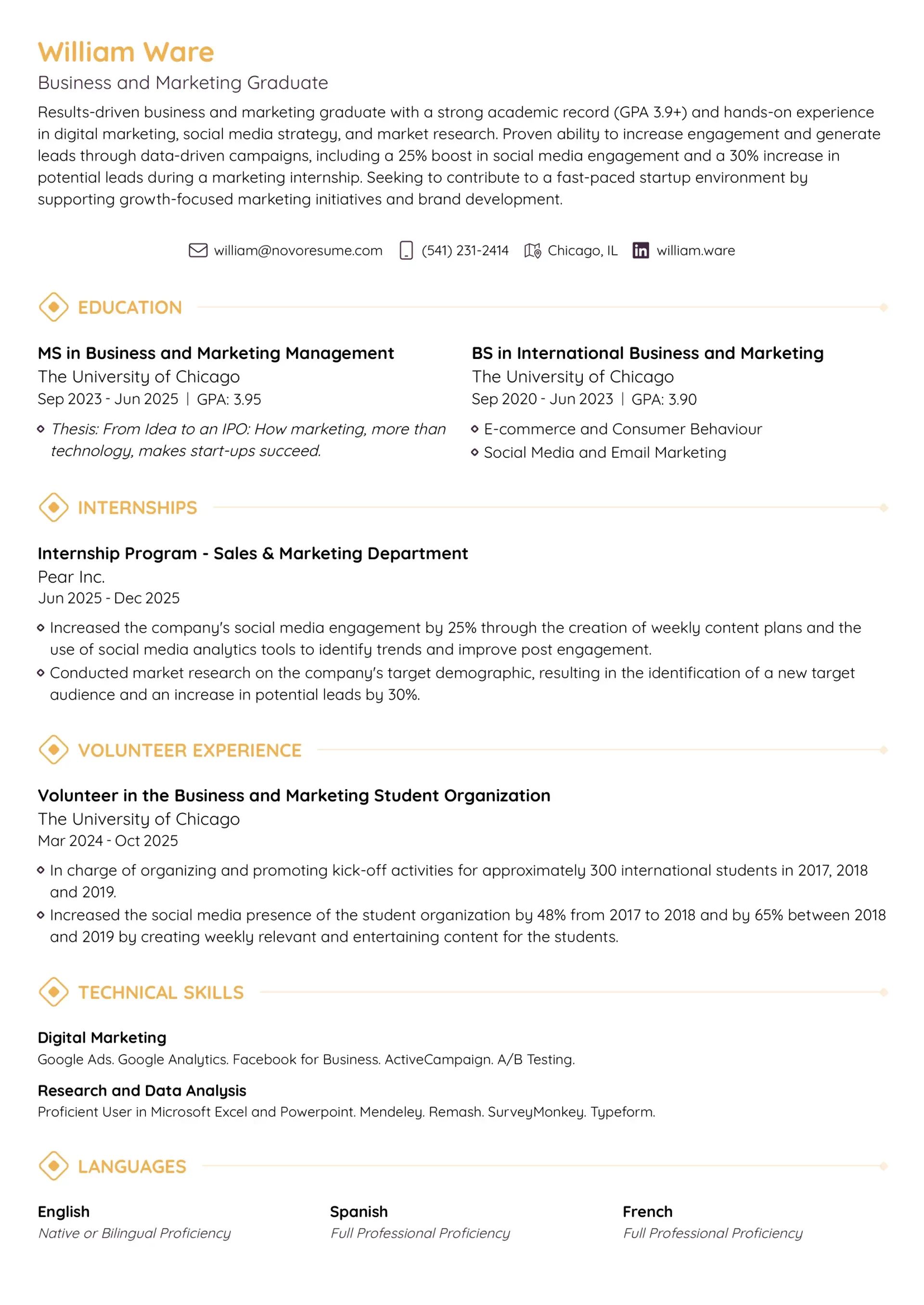
#11. Get Inspired by This First-Job Resume
Need some inspiration for your resume? Check out the resume examples below.
First Job Resume FAQ
Still have some questions on how to write a convincing first job resume?
We’ll answer them here.
Key Takeaways
The short version of a first job resume:
- Use reverse-chronological format. 82% of ATS systems are built to parse it.
- Lead with a two to three sentence resume summary, not an objective.
- Put education directly under the summary, with GPA (if 3.5+), relevant coursework, and honors.
- Replace the Work Experience section with Internships, Projects, Volunteer Experience, or Extracurricular Activities.
- Lean on hard skills pulled from the job description. Soft skills only count if something else on the resume backs them up.
- Keep it to one page, use standard headings, pass it through an ATS check, and match it with a targeted cover letter.
When you're ready to build yours, start with an ATS-tested template from the Novorésumé builder.
Related posts

Resume & CV Writing Tips
Novoresume vs. Resume.io: a direct comparison of ATS compatibility, pricing, AI features, and what you actually get for free. Here's which one is worth your time.

Resume & CV Writing Tips
First job hunt and no experience to list? This 2026 guide shows you exactly what to put on a resume with no work history, plus real examples and recruiter-backed tips.

Resume & CV Writing Tips
Zety's billing complaints are well-documented. Here's how it compares to Novoresume on ATS reliability, AI quality, and what you actually get before the paywall kicks in.