You've organized your resume into clear sections, including contact information, work experience, education, skills, and more.
But have you considered how many individual pieces of information you're actually including?
There's an ideal range that makes your resume easier for both applicant tracking systems (ATS) and hiring managers to parse. It's backed by data from scientists analyzing more than 169,000 resumes.
We're calling it the 88-102 rule, and in this article, we’ll show you how to make it work for you.
We’re going to cover:
- What Is Resume Segmentation?
- Why the 88-102 Rule Matters for Your Job Search
- How to Apply It at Any Career Stage
…and more!
Let's get started.
Want to make a resume that impresses ATS and hiring managers? Use our professional resume builder to create your resume in minutes!
Choose a resume template to get started.
What Is a Resume Segment?
A resume segment is any individual piece of information on your resume that stands alone as a distinct unit, including:
- Each bullet point describing your work experience
- Your contact information (name, job title, phone number, email, LinkedIn URL)
- Job titles and company names
- Degree names and universities
- Section headers (like "Work Experience" or "Personal Projects")
- Individual skills in a skills section
Here's a concrete example:
Work Experience Segments
Marketing ManagerABC Company – 2023-2025- Increased social media engagement by 45% through targeted campaigns.
- Managed a team of 5 content creators.
- Launched three successful product campaigns that generated $500K in revenue.
Pretty short, if you ask us. This single job description comprises six segments. These are:
- Job title (Marketing Manager)
- Company name (ABC Company)
- Employment dates (2020-2023)
- Bullet point #1
- Bullet point #2
- Bullet point #3
When you submit your resume and an applicant tracking system scans it, the ATS breaks down your document into these segments to extract and categorize information. The software identifies what type of information each segment contains – whether it's a job title, a skill, an achievement, or educational background.
The better organized your segments are, the easier it is for both the ATS and hiring managers to scan and understand your qualifications quickly.

The 88-102 Rule, Backed By Data
In 2024, researchers from the Career Science Lab at BOSS Zhipin analyzed more than 169,000 resumes to assess how resume structure affects parsing accuracy and readability.
They found that the average resume in their dataset contained 88.90 segments.
But here's what's interesting: when they looked at resumes that were prepared explicitly for fine-tuning their parsing model, that is, resumes that were carefully reviewed and validated, the average jumped to between 95 and 102 segments.
So, 88-102 segments are the ideal balance. It's enough information to showcase your qualifications comprehensively, but not so much that it overwhelms applicant tracking systems or hiring managers trying to quickly scan your resume.
Resumes in this range had:
- Better parsing accuracy by ATS (the software didn’t miss any important information)
- More transparent hierarchical structure (the relationship between job titles, companies, and achievements)
- More balanced information distribution across sections
The research also revealed that well-structured resumes maintained an average segment length of 15-19 words. This means each bullet point or piece of information should be concise enough to scan yet detailed enough to convey meaning.
To summarize, too few segments likely mean you're omitting essential details about your experience. But too many segments means you're likely including redundant information or breaking things down too granularly.
Why Is Resume Segmentation Important?
Resume segmentation matters in the screening process for two main reasons: ATS compatibility and readability for hiring managers.
When you submit your resume, the ATS doesn't see a beautifully formatted document. It sees data that needs to be extracted and categorized. The software breaks your resume into segments to identify where each piece of information belongs.
If your resume has poor segmentation – say, cramming multiple pieces of information into single lines or using inconsistent formatting – then the ATS might misclassify your information. Your job title could end up in the skills section, or your achievements might get lost entirely.
Proper segmentation, with 88 to 102 distinct pieces of information, clearly signals to the ATS what each element represents. It improves your chances of being parsed correctly and passing the initial screening step.
Next, you need to consider that hiring managers spend an average of six seconds skimming a resume before deciding if they want to read it at all. So, they're not reading every word yet – they're just looking for key information. If you don’t make an impression in that time, your resume is tossed aside.
Well-segmented resumes with clear, scannable bullet points make this process easier. Each segment serves as a visual anchor point, helping hiring managers quickly locate your relevant qualifications and achievements.
Resume Segments vs Resume Length
Let’s get one thing clear: the number of segments in your resume is not the same as how long your resume is.
You could have a one-page resume with over 120 sections if you're using a small font and cramming information. Or you could have a two-page resume with only 60 segments if you're being overly concise.
The research data shows an interesting relationship between segments and page length:
- Pre-training dataset (general resumes): 88.90 segments across an average of 1.95 pages
- Fine-tuned dataset (validated resumes): 95-102 segments across an average of 2.15-2.41 pages
So, what does this tell us? Well-structured resumes with the ideal number of segments are slightly longer (around 2-2.5 pages) because they include comprehensive information without sacrificing readability.
This doesn't mean you should aim for a specific page count. Instead, focus on including the right amount of meaningful information.
If you're a recent graduate, you might hit 88-102 segments in 1-1.5 pages. If you're a senior professional with 15+ years of experience, you might need 2-3 pages to reach that range.
Just make sure it’s balanced with enough segments to fully represent your qualifications, with adequate white space and formatting to keep everything scannable.
How to Apply the 88-102 Rule on Your Resume
Now that you understand what the 88-102 rule is, let's talk about how actually to apply it to your resume.
First, count your current segments. Just go through your resume and tally up every distinct piece of information:
- Contact details (each item counts separately)
- Section headers
- Job titles, company names, and dates for each position
- Every bullet point under each role
- Education entries (degree, school, graduation date, relevant coursework)
- Skills (each skill or skill grouping)
- Certifications, awards, languages, or additional sections
Once you have your count, you might fall into the ideal range of 88-102. In that case, congratulations!
But if you find you have too few (under 88) or too many segments (over 102), your resume still needs some work.
Let's look at how to fix each scenario.
Too Few Segments
If your resume has fewer than 88 segments, you're probably underselling yourself. Here's how to add meaningful information:
- Add relevant skills. Don't just list "Microsoft Office" – break it down into the specific tools you use (Excel, PowerPoint, Word). Include both hard skills (technical abilities) and soft skills (like leadership or communication) that are relevant to your target role.
- Include additional sections. You can leverage optional sections such as certifications and licenses, volunteer work, publications, languages, and more.
Expand your bullet points. Instead of listing basic job duties, break down your impressive achievements into specific, measurable results. One bullet point can transform into several segments with concrete details.
Incorrect Example
- Managed social media accounts.
Correct Example
- Developed social media content strategy across four platforms.
- Increased follower engagement by 65% in 6 months.
- Created 50+ posts monthly that drove traffic to the company website.
Too Many Segments
If your resume has more than 102 segments, you'll likely overwhelm the hiring manager with too much detail. Here's how to streamline things:
- Cut fluff. Remove any generic statements, such as "References available upon request," or obvious skills, such as "proficient in email." Every segment should add genuine value to your application.
- Trim your skills section. Instead of listing 30+ skills, just focus on the 10-15 most relevant to your target role. Group related skills together when it makes sense (e.g., "Adobe Creative Suite: Photoshop, Illustrator, InDesign" counts as one segment rather than listing each Adobe Product separately).
- Remove outdated or irrelevant positions. If you're listing every job you've had since high school, it's time to edit. Focus on the most recent 10-15 years of experience, or roles that are directly relevant to your target position.
- Consolidate similar information. Don’t repeat the same job responsibilities throughout your entire resume. After your very first role in the field, hiring managers will assume you already know how to do the basics. If you have multiple bullet points that essentially say the same thing, you can also combine them into one stronger statement.
Incorrect Example
- Responded to customer emails daily.
- Handled customer phone inquiries.
- Resolved customer complaints through chat support.
Correct Example
Managed customer inquiries across email, phone, and chat channels, resolving 95% of issues on first contact.
Career Stage and Resume Segmentation
Of course, the 88-102 rule isn't a one-size-fits-all solution. Your ideal segment count might depend on where you are in your career.
Entry-Level (0-3 years of experience)
If you're early in your career, aiming for the lower end of the range (88-95 segments) makes the most sense. At this stage, you likely have:
- 1-3 relevant jobs or internships
- Limited professional achievements
- More emphasis on education and skills
So, focus on quality over quantity. Include relevant coursework, academic projects, internships, volunteer work, and transferable skills. Each experience should have 3-4 strong bullet points that demonstrate your capabilities.
Mid-Career (4-10 years of experience)
At this stage, you should comfortably hit the 88-102 range. You have:
- Multiple relevant positions with substantial achievements
- A growing list of skills and certifications
- Enough experience to show career advancement
This is the place where the 88-102 rule naturally applies. You have enough professional experience to write comprehensive bullet points, and you're still focused enough to keep everything relevant.
Senior-Level (10+ years of experience)
For senior professionals, you might naturally exceed 102 segments – and that's okay if the information is relevant. Be strategic about what you include. You should:
- Prioritize leadership achievements and high-level impact
- Reduce detail on older or less relevant positions
- Focus on the last 10-15 years unless earlier experience is very notable
You need to strike a balance between comprehensiveness and scannability, even if you go slightly above 102 segments.
Get the Segmentation Right with Novorésumé
Making a resume can be a hassle. You have to set the line spacing, adjust the page margins, make sure the formatting is neat, and, as you now know, also keep your resume segments in mind.
What if it could be easier?
Try one of our resume templates and create your resume in minutes.
Each template is designed in collaboration with HR professionals to make sure your resume is ATS-friendly, easy to read, professional, and visually appealing.
You can complete your resume in record time and focus on proofreading, ensuring you fall within the 88-102 segment count.
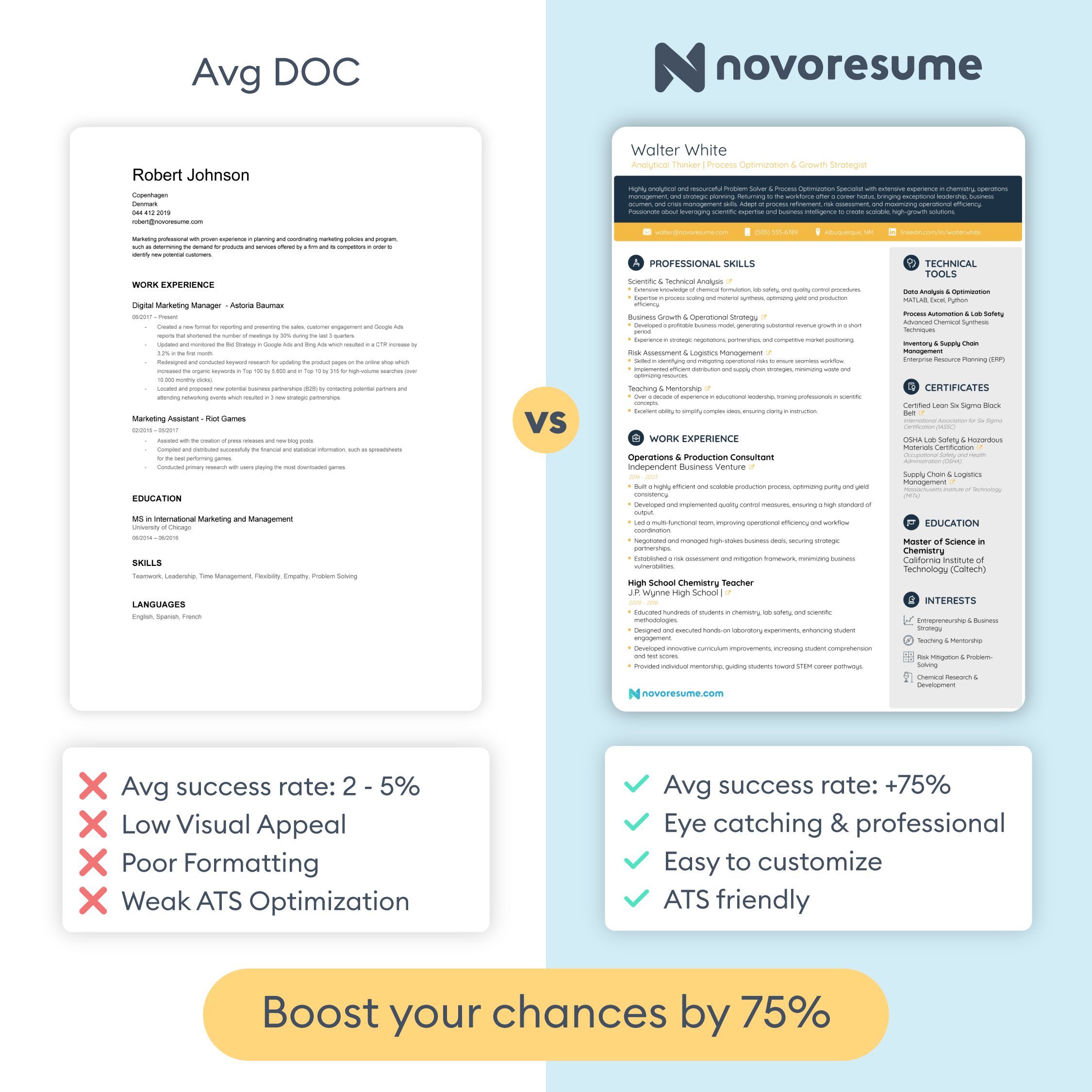
Just see how one of our templates compares to a standard text editor resume template:
Frequently Asked Questions About the 88-102 Rule
Are you still wondering something about the 88-102 rule? Check out answers to some of the most frequently asked questions below:
Key Takeaways
You’ve made it to the end of our article!
By now, you know all there is to know about resume segmentation and how to make it work for you. But before we part ways, let’s just do a quick recap:
- A resume segment is any distinct piece of information on your resume, such as a bullet point, job title, or contact detail. Each segment is parsed separately by applicant tracking systems and hiring managers.
- According to research, well-structured resumes contain between 88 and 102 segments. This range strikes a balance between comprehensive information and readability.
- Proper segmentation improves both ATS compatibility and human scannability. Poorly segmented resumes risk misclassified or overlooked information.
- Segment count is not the same as page length. A one-page resume can have too many segments, while a two-page resume might have too few.
- If you have fewer than 88 segments, expand your bullet points and add relevant sections. If you exceed 102 segments, consolidate similar information and cut outdated or irrelevant details.