Updated on May 11, 2026
UK Cities Where Your Salary Goes the Furthest in 2026
Discover the UK cities where salaries stretch furthest in 2026, with Sheffield, Aberdeen and Coventry beating London on real spending power.


Novoresume got people hired at
























A £37,074 salary in Sheffield gives you more real spending power than £49,692 in London.
That is not a rounding trick. It is what happens when you adjust median workplace salaries for what they actually cost to live in each city, including rent.
Most job seekers compare offers by the number on the contract. But a salary means nothing without knowing what it buys locally. London's median full-time workplace salary is the highest in the UK at £49,692, but after adjusting for local living costs, it drops to an effective £34,119 - dead last among the 22 major UK cities in this study.
We used two datasets to build this ranking. Salary data comes from the Office for National Statistics' Annual Survey of Hours and Earnings (ASHE) 2025 provisional release, specifically the workplace-based earnings component, which measures what jobs in each city actually pay. Cost of living data comes from Numbeo's Cost of Living Plus Rent Index (April 2026), which combines consumer prices and rental costs into a single city-level index. We then normalised the cost index across our 22 cities and divided each city's median salary by its normalised index to calculate a purchasing-power-adjusted salary.
Here is every city ranked by what your pay actually buys.
Full Ranking: 22 UK Cities by Real Purchasing Power
How to read this table: "Median Salary" is the ONS (Office for National Statistics) workplace-based figure for full-time workers. "Cost Index" shows how expensive each city is relative to the average across all 22 cities (100 = average, higher = more expensive). "Adjusted Salary" is the real purchasing power of that salary after local costs. "Change" shows how much value you gain or lose compared to the headline number.
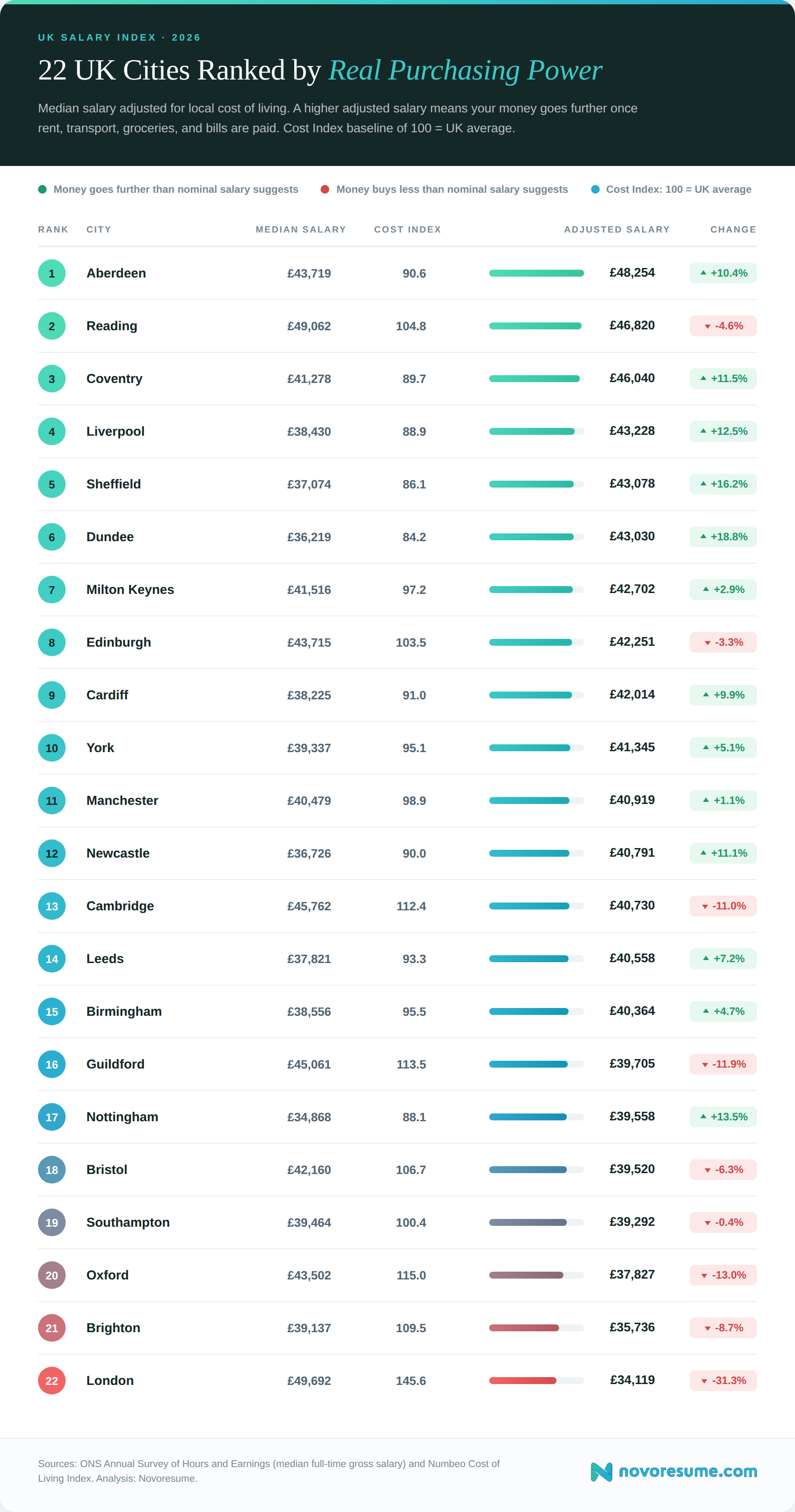
Cities Where Your Salary Punches Above Its Weight
These are the places where the gap between what you earn on paper and what you can actually afford swings sharply in your favour.
Aberdeen – the surprise number one
Aberdeen tops the table, and it is not because of cheap living alone. The city's median workplace salary of £43,719 is the fifth-highest in the study, buoyed by energy sector employers and a professional services cluster that pays well above the national average. But Aberdeen's cost of living sits 9.4% below the 22-city average, largely because its rental market cooled significantly after the 2014-2016 oil price downturn and never fully recovered to peak levels. The result is a salary that stretches to an effective £48,254, the highest adjusted figure of any city.
Coventry – the Midlands value play
Coventry's median workplace salary of £41,278 looks unexceptional until you factor in costs that sit 10.3% below average. Adjusted, it becomes £46,040, placing third nationally. The city benefits from a concentration of automotive and advanced manufacturing employers (Jaguar Land Rover is headquartered in Whitley, on the south side of Coventry) that push salaries above typical Midlands levels, while rents and daily costs track closer to Birmingham and Wolverhampton than to London or the South East.
Sheffield, Liverpool, and Dundee – the purchasing power belt
These three cities share a pattern: moderate nominal salaries that punch well above their weight after adjustment.
Sheffield's £37,074 median rises to £43,078 after adjustment, a 16.19% increase. Liverpool's £38,430 becomes £43,228 (+12.5%). Dundee's £36,219 becomes £43,030 (+18.8%, the largest percentage gain in the study).
All three have combined living costs that sit 11-16% below the 22-city average, with rent being the single biggest driver of that gap. For job seekers in sectors with employer presence in these cities - digital, professional services, advanced manufacturing, life sciences - the financial case for these locations over London or the South East is substantial.
Edinburgh – high salary, reasonable costs
Edinburgh is the rare city that delivers both a strong headline number and a strong adjusted value. Its £43,715 median is the third-highest in the study, and its adjusted salary of £42,251 holds onto most of that because costs, while above average at 103.5, are only modestly so. It ranks 8th overall; the best-of-both-worlds option for people who want a high nominal salary without a punishing cost-of-living penalty.
Cities Where Your Salary Quietly Disappears
Not every city that looks good on paper delivers what it promises.
London – the £15,573 haircut
London's median workplace salary of £49,692 is the highest in the UK. But London's cost of living, including rent, sits 45.6% above the 22-city average, and after adjustment, that salary falls to £34,119.
That places London 22nd out of 22, below every other city in the study.
This means that a median worker in Sheffield (£37,074) has roughly £8,959 more in annual purchasing power than a median worker in London (£49,692). The London worker earns £12,618 more on paper but loses £15,573 to higher living costs. That is not a small gap. It is the difference between saving for a deposit and not saving for one.
This does not mean London is always the wrong choice. London offers career trajectories, sector depth, and salary ceilings that most UK cities cannot match. If your career path leads to £80k+ roles that simply do not exist elsewhere, London's cost premium becomes a smaller share of the total. But for workers earning around the median, the maths is stark.
Oxford, Cambridge, and Guildford – the knowledge economy tax
Oxford loses 13.0% of its salary to costs. Guildford loses 11.9%. Cambridge loses 11.0%. All three cities have high nominal salaries driven by university-linked and knowledge-economy employers, combined with housing markets inflated by constrained supply and high demand. Cambridge's median workplace salary of £45,762 looks impressive, but in real terms it buys less than the median in Cardiff (£38,225), York (£39,337), or Newcastle (£36,726), cities where workers earn £6,000-9,000 less on paper.
Brighton – the coastal premium
Brighton's tech scene and London spillover economy push its median to £39,137, but costs 9.5% above the average erode it to just £35,736, second-from-bottom. Only London fares worse.
What This Means for Job Seekers
This data reframes how you should approach job offers across different UK cities.
Adjust for costs before comparing offers. A £38k offer in Liverpool is worth more in real terms than a £43k offer in Oxford. If you are weighing offers across cities, this table gives you a starting framework for understanding what those numbers actually buy.
Remote work is the single biggest financial lever available. If you can earn a London salary while living in Sheffield, Liverpool, Coventry, or Dundee, you are effectively boosting your purchasing power by roughly 60-70% compared to spending that same wage in London. Even moving from a Reading or Guildford salary to one of these cities delivers a 20-30% real-terms boost. The rise of hybrid working has made this a realistic option for many knowledge workers.
London makes financial sense at above-median salaries, but the threshold is higher than most people think. At median earnings, London's cost of living consumes so much income that 21 other cities offer better purchasing power. The breakeven point at which London's salary premium starts to outweigh its cost penalty depends on your field and career trajectory, but for many workers, it is well above £50k.
Do not underestimate mid-tier cities. Coventry, Liverpool, Sheffield, and Dundee all deliver top-six purchasing power. None of them feature on typical "best places to work" lists, which is partly why their cost-to-salary ratios remain so favourable.
Methodology
Salary data: Office for National Statistics, Annual Survey of Hours and Earnings (ASHE) Table 7 - workplace-based analysis by local authority, 2025 provisional release (reference period: April 2025). We used median gross annual pay for full-time employees. For individual cities, we used local authority-level data accessed via the Nomis API. For London, we used the ONS regional workplace median (£49,692) rather than aggregating borough-level figures, as the regional figure better reflects the distribution of employment across boroughs.
Cost-of-living data: Numbeo Cost of Living Plus Rent Index, April 2026 update. This index combines consumer goods and services prices with residential rental costs, benchmarked against New York City (NYC = 100). We used the rent-inclusive index rather than the rent-excluded Cost of Living Index because housing is the largest single cost differentiator between UK cities, and excluding it would understate regional price gaps.
Calculation method: We normalised Numbeo's index values so that the mean across all 22 cities in the study equals 100. We then divided each city's median workplace salary by its normalised index to produce a purchasing-power-adjusted salary. This figure represents what the median salary actually buys relative to the average city in our dataset.
Excluded cities: Glasgow, Belfast, and Bournemouth were excluded because their ONS workplace salary figures were suppressed in the 2025 ASHE release (status code Q - "figures are missing"). All three cities have Numbeo cost data available, but it could not be included without a valid salary figure.
Important caveats: Numbeo's indices are derived from crowdsourced user submissions, not official government statistics. While Numbeo is widely used for city-level cost comparisons and its sample sizes for major UK cities are large enough to be directionally reliable, it does not carry the same statistical authority as ONS data. Individual spending patterns, especially housing tenure (renting vs. owning), household composition, and commuting costs, create significant variation around any city-level average. This analysis represents the experience of a median full-time worker; individual results will vary.
 Add Novorésumé as a preferred source on Google
Get more resume writing tips, career insights, and job search advice in your personalized Google search results.
Related posts

Job Interviews & Find A Job
Words and adjectives to describe yourself in interviews, on your resume, and in bios. Grouped by trait, with worked answers and the 10 words to avoid.

Job Interviews & Find A Job
100+ AI hiring statistics for 2026: employer adoption, AI resumes and cover letters, interview cheating, and detection rates, from our four 2026 surveys.

Job Interviews & Find A Job
90+ Gen Z workplace statistics for 2026: workforce share, the entry-level squeeze, AI, tenure, money, and the management myths. From 20+ primary sources.