The U.S. job market recovery has been uneven, and new data shows just how dramatic the gap has become between cities. An analysis of federal labor market and cost-of-living data across the 49 largest metro areas reveals that a job search in San Francisco takes an estimated 40 weeks - more than three times the 12-week average in Birmingham, Alabama.
The analysis combines the Bureau of Labor Statistics' Job Openings and Labor Turnover Survey (JOLTS) with the Bureau of Economic Analysis' Regional Price Parities (RPP) to rank every major U.S. metro by job-search difficulty. The results paint a clear geographic divide: the West Coast dominates the hardest-to-find-work list, while the Southeast leads the easiest.
What the data shows:
- Job seekers in San Francisco face an estimated 40-week search, the longest of any major U.S. metro
- All 6 of the hardest metros are in California. All top 8 are on the West Coast
- Birmingham, Alabama is the easiest metro for finding work at just 12 weeks - 3.4x faster than San Francisco
- Only 16 of 49 major metros are harder than the national average, meaning most large cities are actually better than the baseline
- The gap between hardest and easiest metros has widened: a San Francisco job seeker waits 28 more weeks than one in Birmingham
California Claims All 6 of the Hardest Metro Areas
California's labor market stands out as the toughest in the country. The state has 1.57 unemployed workers competing for every job opening - well above the national average of 1.1. When paired with the Bay Area's cost of living (roughly 18% above the national average), the result is a job-search environment that is 69% more challenging than the rest of the country.
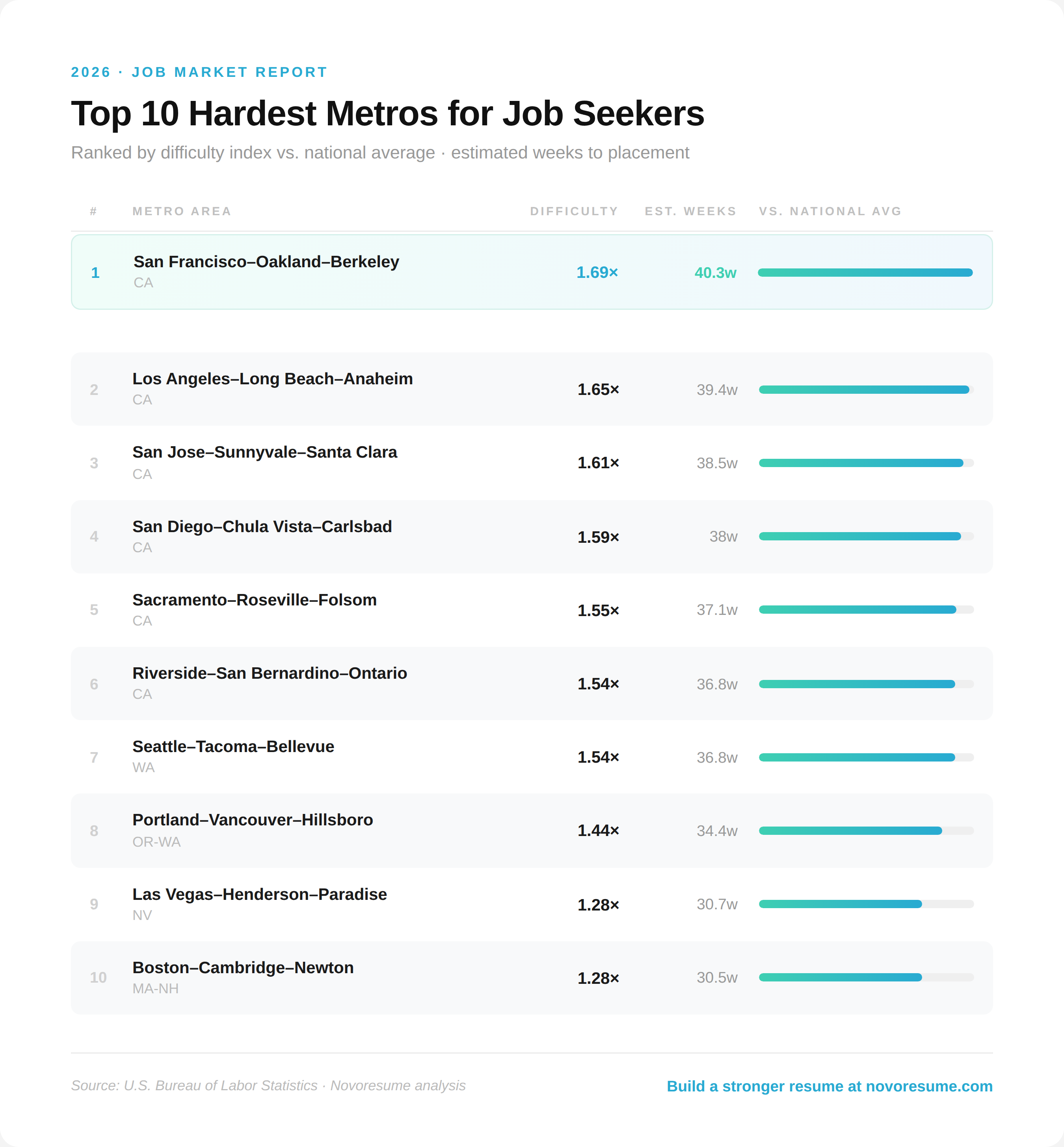
Six California metros occupy the top six spots in the ranking. San Francisco leads at 40.3 weeks, followed closely by Los Angeles (39.4 weeks), San Jose (38.5 weeks), San Diego (38.0 weeks), Sacramento (37.1 weeks), and Riverside (36.8 weeks).
Even Riverside - which has one of the lowest costs of living among California metros - still ranks as the sixth-hardest city in the country, purely because of the state's high ratio of job seekers to openings. This underscores how much state-level labor market conditions drive the results in California.
Top 10 Hardest Metros for Job Seekers
"In a market like San Francisco, the spray-and-pray approach is a losing strategy," says Andrei Kurtuy, CMO at Novoresume. "When there are 1.57 seekers per opening, the people who land fastest are the ones treating every application like a pitch deck - tailored, data-driven, and impossible to ignore."
The Entire West Coast Is Above the National Average
It's not just California. Every major West Coast metro area ranks above the national average for job-search difficulty.
Seattle comes in at number 7, with an estimated 36.8 weeks. Washington state has 1.5 unemployed workers per opening, and Seattle's cost of living (about 13% above average) compounds the challenge. Portland follows at number 8 with 34.4 weeks, driven by Oregon's high ratio of 1.48 unemployed per opening.
The West Coast sweep of the top 8 slots is notable because these metros span very different economic profiles - from tech-heavy San Jose and Seattle to logistics-oriented Riverside and the tourism-driven economy of San Diego. Regardless of industry mix, the combination of labor market slack and high living costs produces consistently long job searches.
Las Vegas and Boston round out the top 10 at 30.7 and 30.5 weeks, respectively. Las Vegas is propelled by Nevada's steep 1.45 unemployed-per-opening ratio - one of the highest in the country - while Boston's result is driven more by its high cost of living (RPP of 111.6).
2 in 3 Major Metros Are Actually Easier Than the National Average
Despite the headline-grabbing numbers at the top, the majority of U.S. metros are better for job seekers than the national baseline suggests.
Only 16 of 49 major metros scored above 1.0 on the difficulty index, meaning 33 metros offer a job-search experience that is easier than average. The national average of 23.9 weeks is being pulled up by conditions in a relatively small number of expensive, high-competition markets.
For context, mid-range cities like Denver (23.6 weeks), Phoenix (23.4 weeks), and Orlando (23.3 weeks) all land almost exactly at the national average. The job search in these metros is neither notably harder nor notably easier than what most Americans experience.
Meanwhile, cities like Dallas (21.5 weeks), Houston (20.9 weeks), Austin (20.4 weeks), and Salt Lake City (20.3 weeks) come in comfortably below average. Texas metros benefit from a statewide ratio of just 0.96 unemployed per opening, combined with moderate costs of living.
Birmingham and Atlanta Lead the Southeast Job Market Advantage
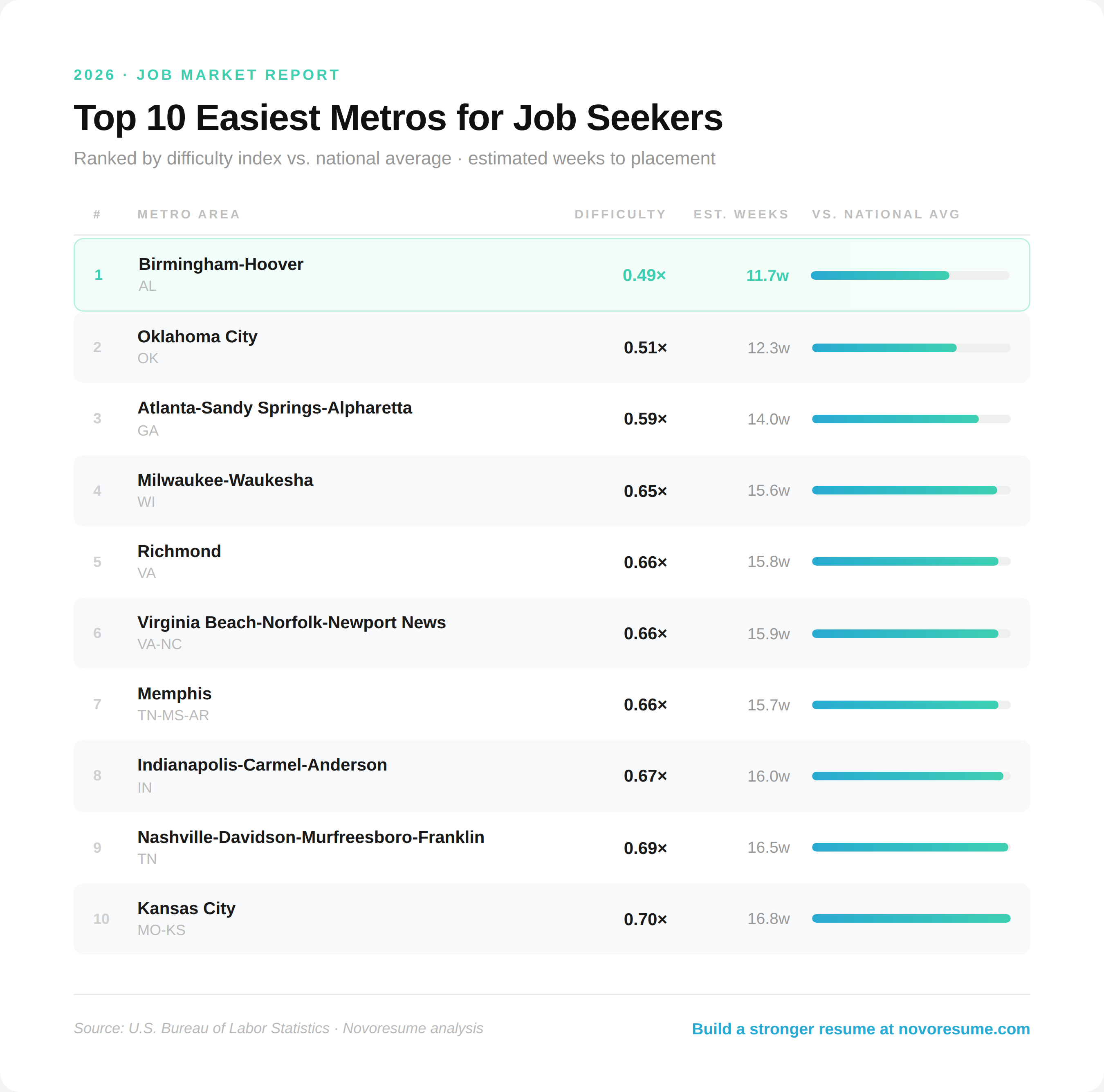
At the other end of the spectrum, the Southeast dominates the easiest-metro list. Birmingham tops it with an estimated 11.7 weeks - a difficulty index of just 0.49, meaning it is roughly half as hard as the national average.
Alabama has only 0.58 unemployed workers per job opening, one of the lowest ratios in the country, and Birmingham's cost of living sits about 8% below the national average. The combination creates what is effectively the most favorable job market among major U.S. metros.
Atlanta comes in third-easiest at 14.0 weeks. Georgia's labor market has just 0.64 unemployed workers per opening, and the metro's cost of living is essentially at the national average. For job seekers weighing a relocation from the West Coast, the math is striking: the same search that takes 40 weeks in San Francisco could take just 14 in Atlanta.
"Most people underestimate how much location alone affects their odds," says Andrei Kurtuy, CMO at Novoresume. "A remote-eligible worker spending 10 months hunting in LA could target Atlanta, land a role in three, and come out ahead financially even after moving costs. Geographic arbitrage is one of the most underused job search tactics right now."
Oklahoma City (12.3 weeks), Milwaukee (15.6 weeks), Richmond (15.8 weeks), and Nashville (16.5 weeks) also rank among the easiest metros.
Top 10 Easiest Metros for Job Seekers
New York, Chicago, and DC All Hover Just Above the National Average
Several of the country's largest and most well-known metros land in a narrow band just above the national average, ranking between 11th and 17th on the difficulty index.
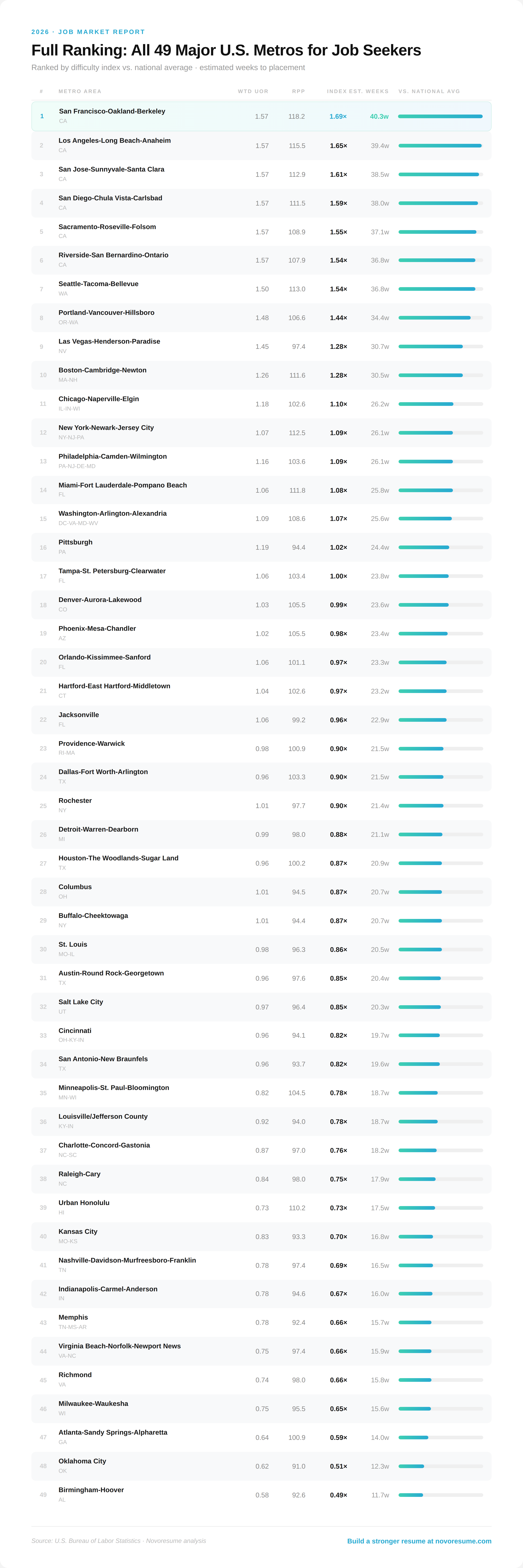
Chicago (26.2 weeks), New York (26.1 weeks), Philadelphia (26.1 weeks), Miami (25.8 weeks), and Washington, D.C. (25.6 weeks) all cluster between 1.07x and 1.10x on the index. While these cities are technically harder than average, the difference is modest - only two to three weeks longer than the national baseline.
For multi-state metros like New York (NY-NJ-PA), Chicago (IL-IN-WI), and Washington (DC-VA-MD-WV), this analysis uses employment-weighted averages of each state's labor market data to produce a more accurate picture. Washington, D.C. is a notable example: D.C. proper has 1.9 unemployed per opening, but the Virginia and Maryland suburbs - where the majority of metro workers are employed - have much lower ratios (0.74 and 0.95, respectively). The blended result of 1.09 paints a more realistic picture of the metro as a whole.
What This Means for Job Seekers
The data suggests that where you search for a job matters almost as much as how you search. A worker in San Francisco can expect to spend nearly 10 months finding a new role, while someone with a comparable profile in Birmingham might land one in under three months.
For workers considering relocation, the gap is dramatic enough to be a deciding factor. Moving from the Bay Area to Atlanta could cut a job search by more than six months. Even a move from Los Angeles to Dallas could shave nearly 18 weeks off the timeline.
Workers who cannot relocate but live in high-difficulty metros should plan for a longer search. Job seekers in the top 10 hardest metros may need seven to ten months of savings to sustain their search - a much larger financial cushion than the three to five months typically recommended.
"If the data says your city averages a 37-week search, budget for that - not for the five-month timeline your friend in Nashville had," says Andrei Kurtuy, CMO at Novoresume. "Cut your burn rate early, not when you're already stressed at month six."
Full Ranking: All 49 Major U.S. Metros
Methodology
This analysis uses a job-search difficulty index that combines two publicly available federal datasets to estimate how long it takes to find a job in each of the 49 largest U.S. metropolitan areas.
Average weeks unemployed. The Current Population Survey's Average Weeks Unemployed series (UEMPMEAN) shows that the typical unemployed American spent 23.9 weeks looking for work in January 2026. This serves as the national baseline.
Job-posting pressure. The ratio of unemployed persons per job opening is drawn from the BLS Job Openings and Labor Turnover Survey (JOLTS) for November 2025 (released January 27, 2026). Because BLS does not publish metro-level JOLTS data, this analysis uses state-level ratios as a proxy. For metro areas that span multiple states - such as New York (NY-NJ-PA), Chicago (IL-IN-WI), and Washington, D.C. (DC-VA-MD-WV) - the analysis uses an employment-weighted average of each state's ratio, with weights based on each state's approximate share of the metro's total employment. This prevents any single state (particularly small but extreme-ratio jurisdictions like D.C.) from disproportionately skewing the result.
The national ratio in November 2025 was 1.1 unemployed persons per job opening. Each metro's weighted state ratio is divided by this national figure to produce a relative measure of labor market slack. For example, California's ratio of 1.57 divided by the national 1.1 yields a relative ratio of 1.43, meaning California's labor market is about 43% slacker than the national average.
Cost of living. The Regional Price Parity (RPP) index from the Bureau of Economic Analysis for 2023 (the most recent year available, released December 2024) measures each metro area's price level relative to the national average. An RPP of 118.2 for San Francisco means prices there are about 18% higher than the U.S. overall.
Index formula. Job-search difficulty index = (metro weighted UOR / national UOR) x (metro RPP / 100). A value of 1.0 means the metro area matches the national average. Values above 1.0 indicate greater difficulty; values below 1.0 indicate an easier job market. Multiplying the index by the national average of 23.9 weeks produces an estimated job-search duration for each metro.
Limitations. These estimates rely on state-level job-opening ratios rather than metro-level data, which BLS does not currently publish for JOLTS. Actual conditions within a metro area may differ from the statewide average - particularly in large states like California or Texas, where individual metros have distinct economic profiles. The RPP data is from 2023, and local price levels may have shifted since then. Employment weights for multi-state metros are approximations based on BLS Quarterly Census of Employment and Wages data. These figures should be treated as indicative estimates that illustrate the relative difficulty of job searching across metro areas, rather than precise predictions of individual outcomes.
Data sources. U.S. Bureau of Labor Statistics (Job Openings and Labor Turnover Survey, Local Area Unemployment Statistics, Current Population Survey); U.S. Bureau of Economic Analysis (Regional Price Parities, 2023).


























 Add Novorésumé as a preferred source on Google