47% of Workers Use AI to Finish Work Early [2026 Study]
New survey of 1,000 U.S. workers finds 47% use AI to finish work faster and spend the extra time on personal activities - and their employers have no idea.
Nearly half of workers who use AI at work are already done before the day ends. They're finishing their tasks faster, then spending the remaining hours on personal activities - on the clock, with their employer none the wiser.
We surveyed 1,000 U.S. full-time workers in February 2026 to find out how AI is actually changing the workday. Of those surveyed, 86% currently use AI tools for work. And what they're doing with the time AI frees up is something most employers haven't caught onto yet.
Study highlights:
47% of AI-using workers finish their work faster with AI, then spend the extra time on personal activities while on the clock
Of those workers, more than half say they could do their job at the same level without AI - they're not dependent, just faster
Only 4% of AI users say they couldn't do their job without the technology
6 in 10 AI-using workers feel zero guilt about how they use AI - they see it as just a tool
Millennials lead at 55%, with Gen Z close behind at 49%
58% of workers say their job is safe from AI entirely
Nearly Half the Workforce Is Quietly Working a Shorter Day
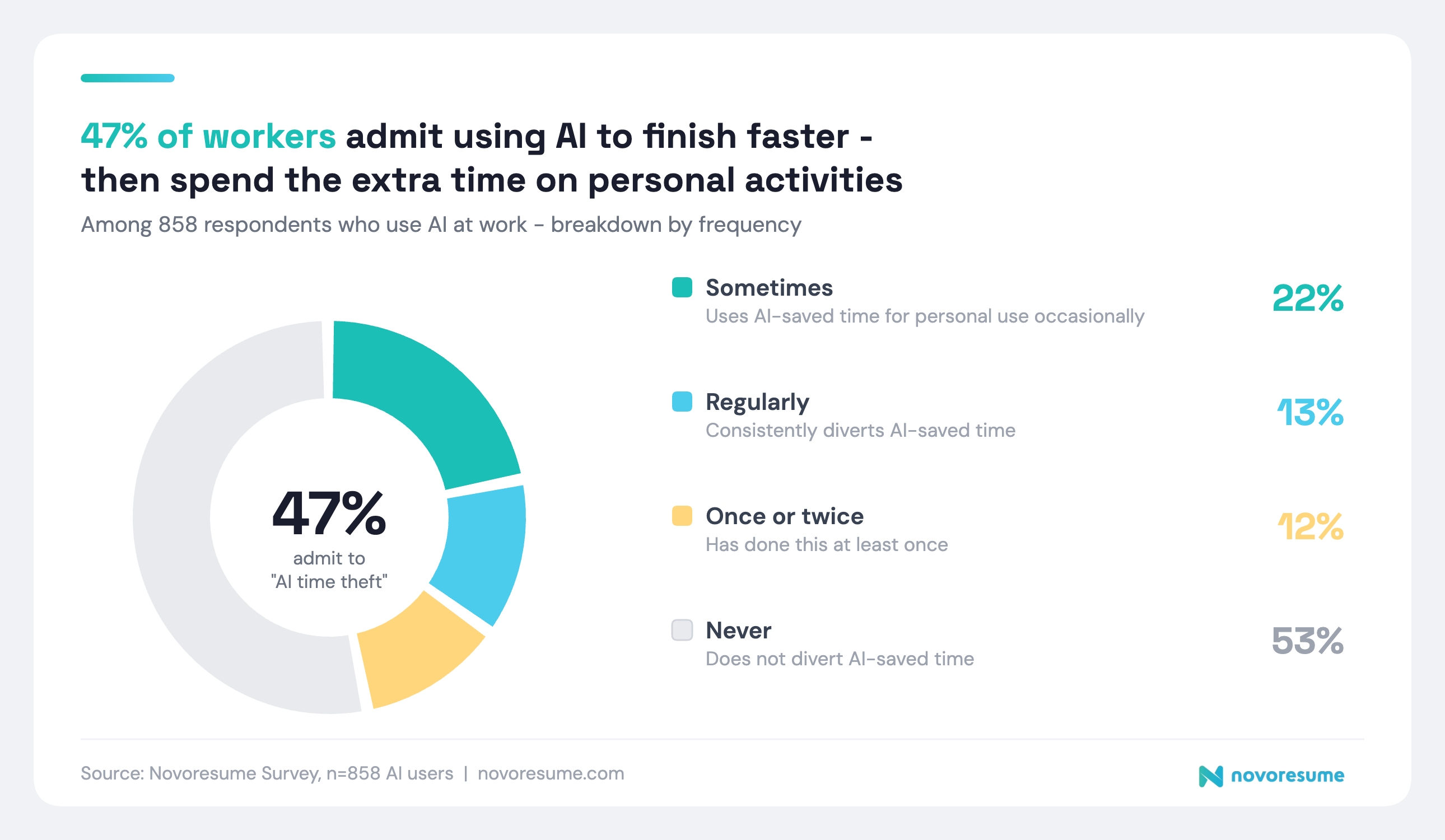
Of the 858 respondents who use AI at work, 47% admit they've used the technology to finish their work faster and then spent the extra time on personal activities while still on the clock. Of this group, 22% do this sometimes, 13% do it regularly, and 12% have done it once or twice.
The work is still getting done. Among workers who reclaim time this way, 55% say they could perform their job at the exact same level without AI. They haven't become dependent on the technology. They're simply using it to compress a full day's output into fewer hours - and keeping the difference for themselves.
"This is what happens with every productivity tool - workers absorb the gains first, and employers catch up later," says Andrei Kurtuy, career expert at Novoresume.com. "When spreadsheets replaced manual calculations, no one expected accountants to do twice the math. Workers used the time savings to take on different tasks or simply breathe. AI is following the exact same pattern, just at a much faster pace."
The difference this time is scale. Spreadsheets shaved minutes. AI is shaving hours.
96% of Workers Could Drop AI Tomorrow and Still Do Their Jobs
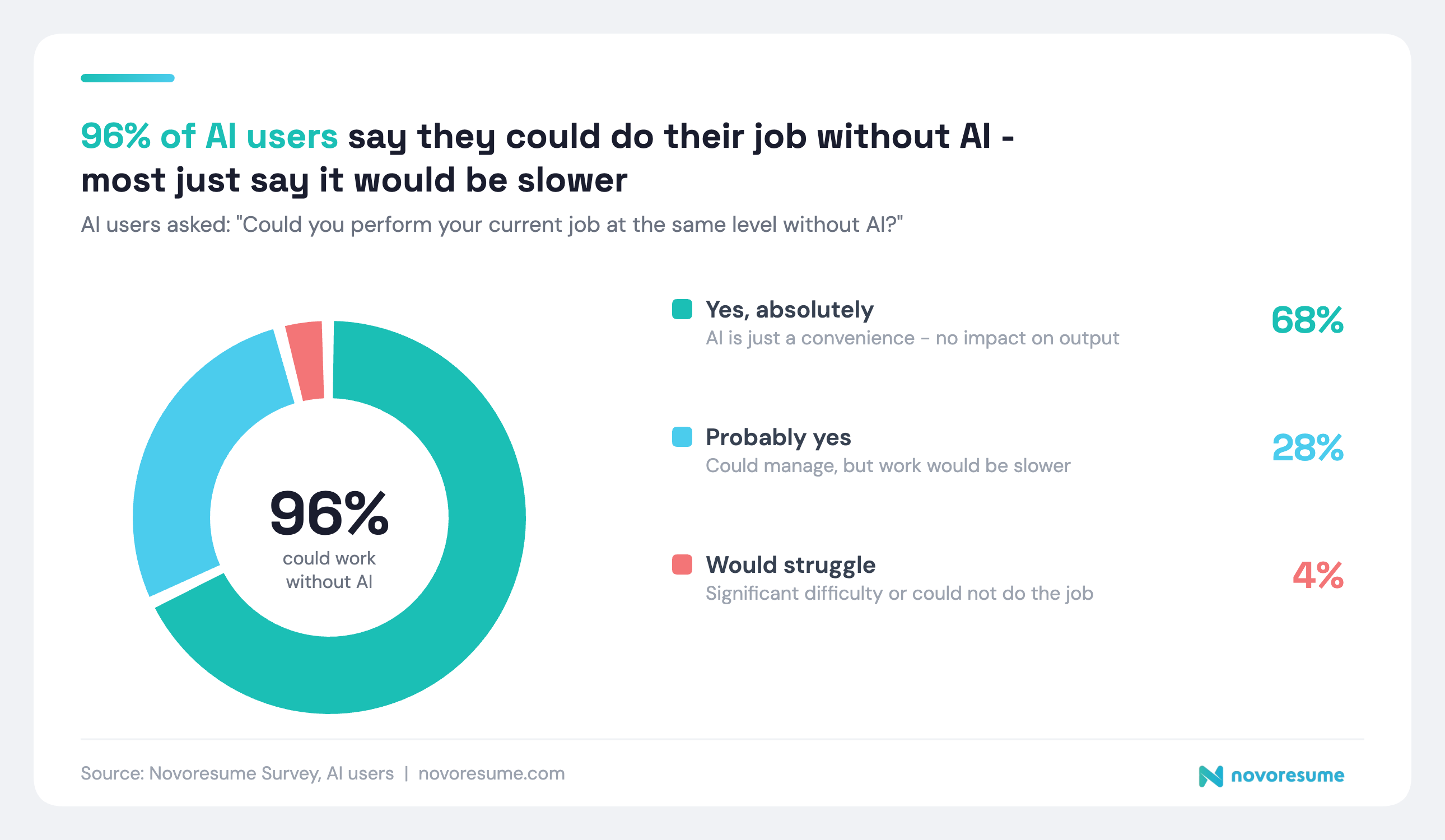
When asked whether they could perform their current job at the same level without AI, 68% of AI users say yes absolutely - it's just a convenience. Another 28% say they probably could, but their work would be slower. Only 4% say they'd struggle significantly or couldn't do their job at all.
When asked if their employer would discover they're less capable than currently perceived if AI vanished tomorrow, the overwhelming majority say no. A total of 43% say definitely not, and 24% say probably not. Only 21% think they'd be exposed.
The "what would you do if AI were banned" question tells a similar story. The majority - 53% - say it wouldn't affect them much. About 13% say they'd actually welcome a ban. Only 7% would quit or start job hunting, and 10% admit they'd keep using AI secretly.
Workers aren't leaning on AI because they have to. They're leaning on it because it lets them get to 5pm's worth of output by 2pm. The tool is optional. The time savings aren't something they plan to give back.
"AI has exposed a gap between how long work actually takes and how long workers are expected to be at their desks," says Andrei Kurtuy, career expert at novoresume.com. "That gap existed before AI - it just wasn't this visible."
6 in 10 Workers Feel No Guilt - and the Guilt Phase May Already Be Over
The survey asked AI-using workers to describe how they feel about their AI use at work. Most of them have made their peace with it.
The most common response, selected by 59% of AI users, was "I feel no guilt - it's just a tool." Another 30% say they feel smart for being more efficient, 29% say everyone is doing it, and 24% feel proud for embracing new technology.
Only a small minority report negative feelings. Just 10% feel like they're cheating, 9% are anxious about AI replacing them, 5% feel guilty about how much AI does for them, and 5% feel like an imposter.
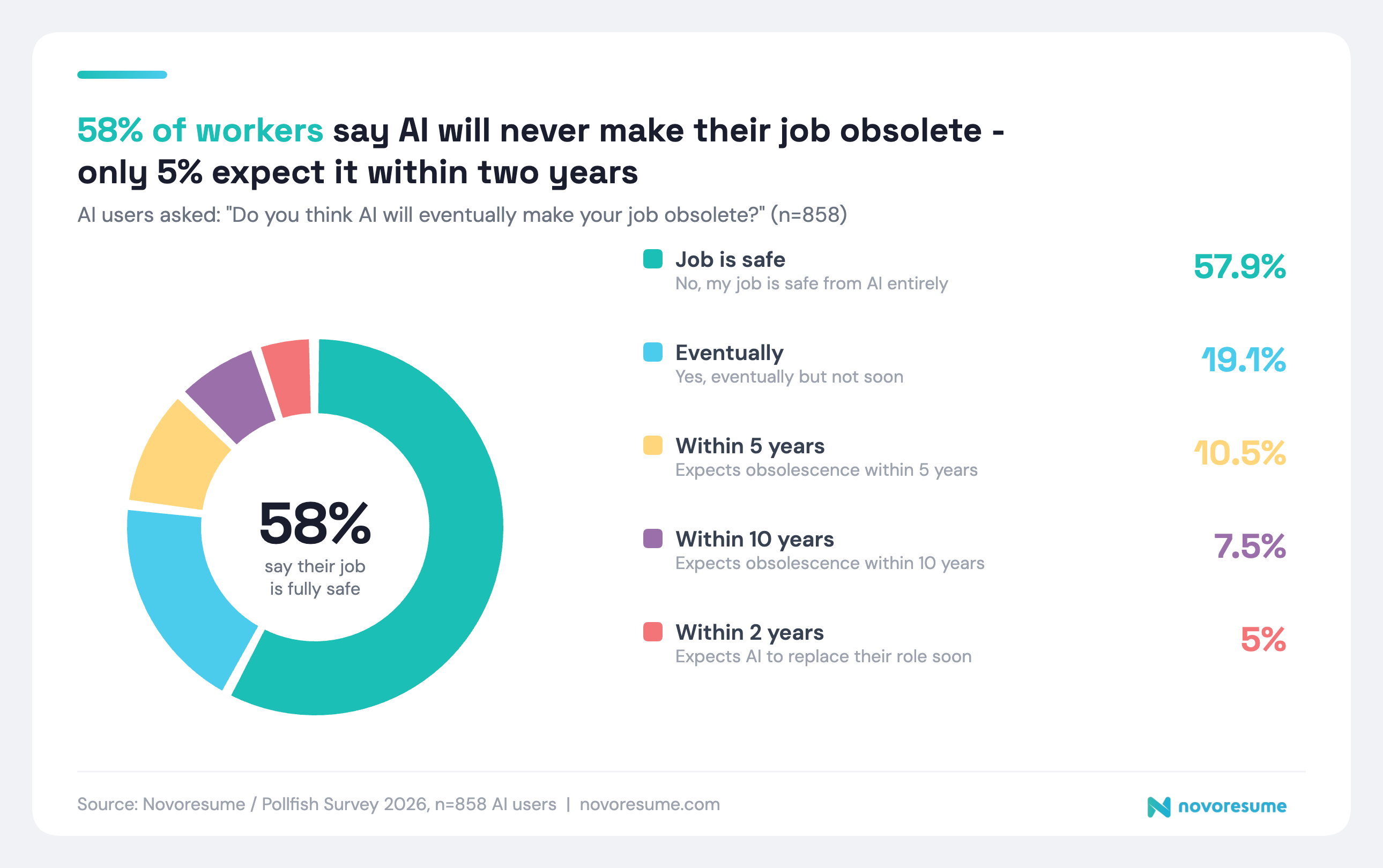
Workers' confidence extends to their job security as well. When asked whether AI will eventually make their job obsolete, 58% say their job is safe from AI entirely. Of those who do see obsolescence on the horizon, 19% say it will happen eventually but not soon, while only 5% believe it's coming within two years.
"When 6 in 10 workers feel no guilt and only 1 in 10 feels like they're cheating, you're looking at a technology that's been fully normalized," says Andrei Kurtuy, career expert at Novoresume.com. "Employers who are still debating whether to allow AI are having last year's conversation. Their employees moved on months ago."
This Isn't a Gen Z Thing - Everyone Under 44 Is Doing It
The biggest generational split in the data isn't between Gen Z and everyone else - it's between workers under and over 44.
Among Millennials (ages 29-44), 55% have used AI to free up time for personal activities during work hours. Gen Z (ages 18-28) is right behind at 49%. But once you cross the age line, the numbers drop: Gen X (ages 45-60) comes in at 40%, and Boomers (61+) at 36%.
The pattern holds for regular use too. About 19% of Gen Z and 18% of Millennials say they do this routinely, compared to 8% of both Gen X and Boomers.
Worth noting: even among Boomers, more than a third have done this. This isn't a fringe behavior confined to one demographic. It's happening across the workforce. The under-44 crowd is just less shy about it.
"When you see the same behavior across both Gen Z and Millennials at nearly identical rates, that's not a generational quirk," says Andrei Kurtuy, career expert at Novoresume.com. "That's the new normal spreading from the bottom up."
What Happens When Employers Catch On
Right now, workers are absorbing AI's productivity gains quietly. The output stays the same, the hours shrink, and no one on the management side has had reason to look too closely.
That won't last forever. When employers do catch on, the response could go several ways. Some will demand more output for the same hours. Some will cut hours and pay. Others might restructure roles entirely. And some - probably more than you'd expect - will just keep not looking.
But the gap is real, and it's growing. Nearly half of AI-using workers have already quietly reshaped what their workday actually looks like. The only question is when the org chart catches up.
100+ AI hiring statistics for 2026: employer adoption, AI resumes and cover letters, interview cheating, and detection rates, from our four 2026 surveys.
90+ Gen Z workplace statistics for 2026: workforce share, the entry-level squeeze, AI, tenure, money, and the management myths. From 20+ primary sources.


























 Add Novorésumé as a preferred source on Google