90+ Gen Z Workplace Statistics for 2026 (New Data)
90+ Gen Z workplace statistics for 2026: workforce share, the entry-level squeeze, AI, tenure, money, and the management myths. From 20+ primary sources.


Novoresume got people hired at
























Key Findings
- Gen Z makes up just under 20% of the US workforce, and 1 in 10 US managers is now Gen Z (Glassdoor analysis of Census data).
- Recent-graduate unemployment sits at 5.7%, and for the first time in a series going back to 1990, recent grads are more likely to be unemployed than the average worker (New York Fed).
- Early-career workers aged 22-25 in the most AI-exposed occupations have seen a 16% relative employment decline since late 2022 (Stanford analysis of ADP payroll data).
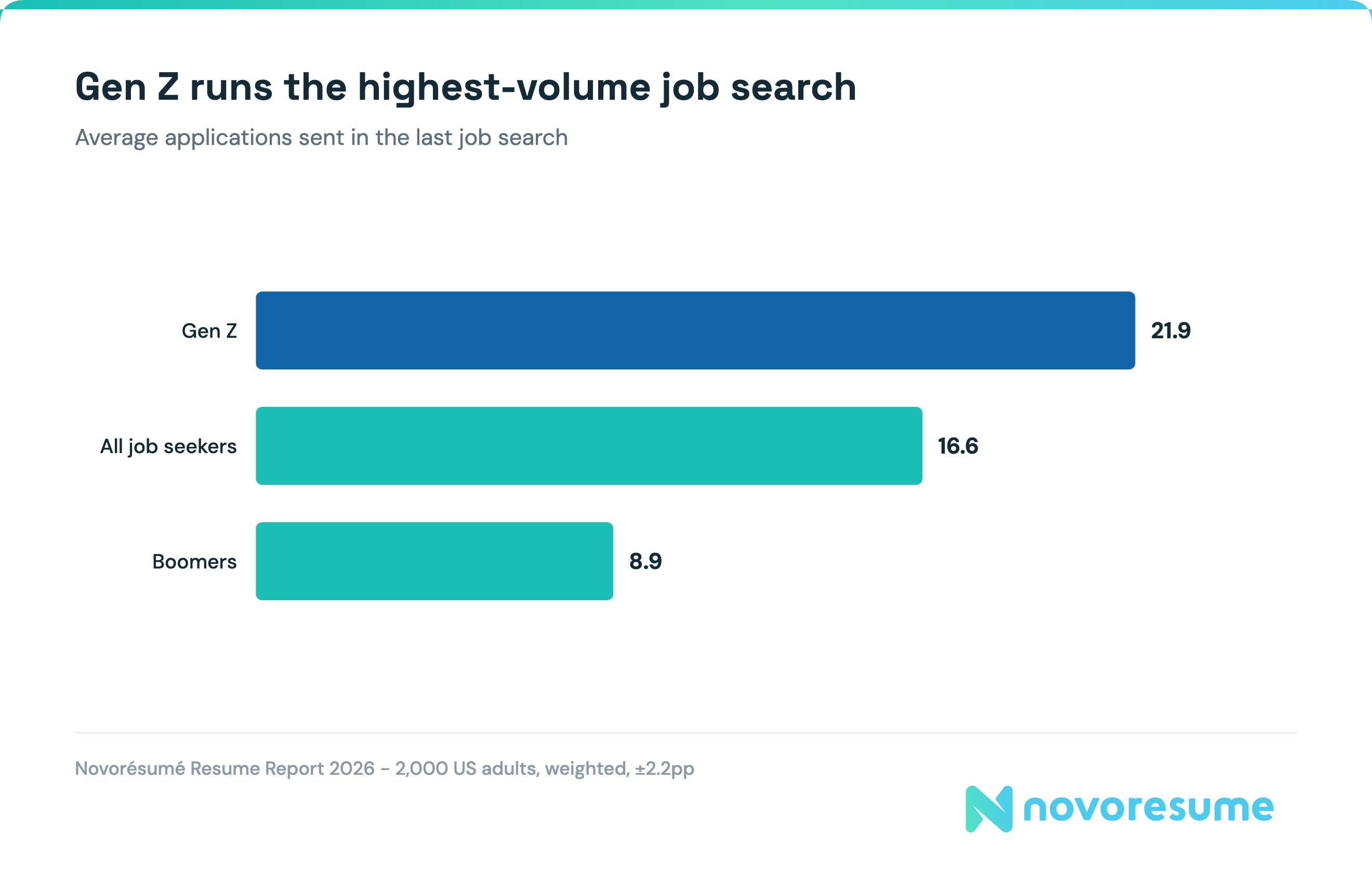
- Gen Z runs the highest-volume job searches: 21.9 applications per search versus 16.6 for the average job seeker, per our 2026 Resume Report.
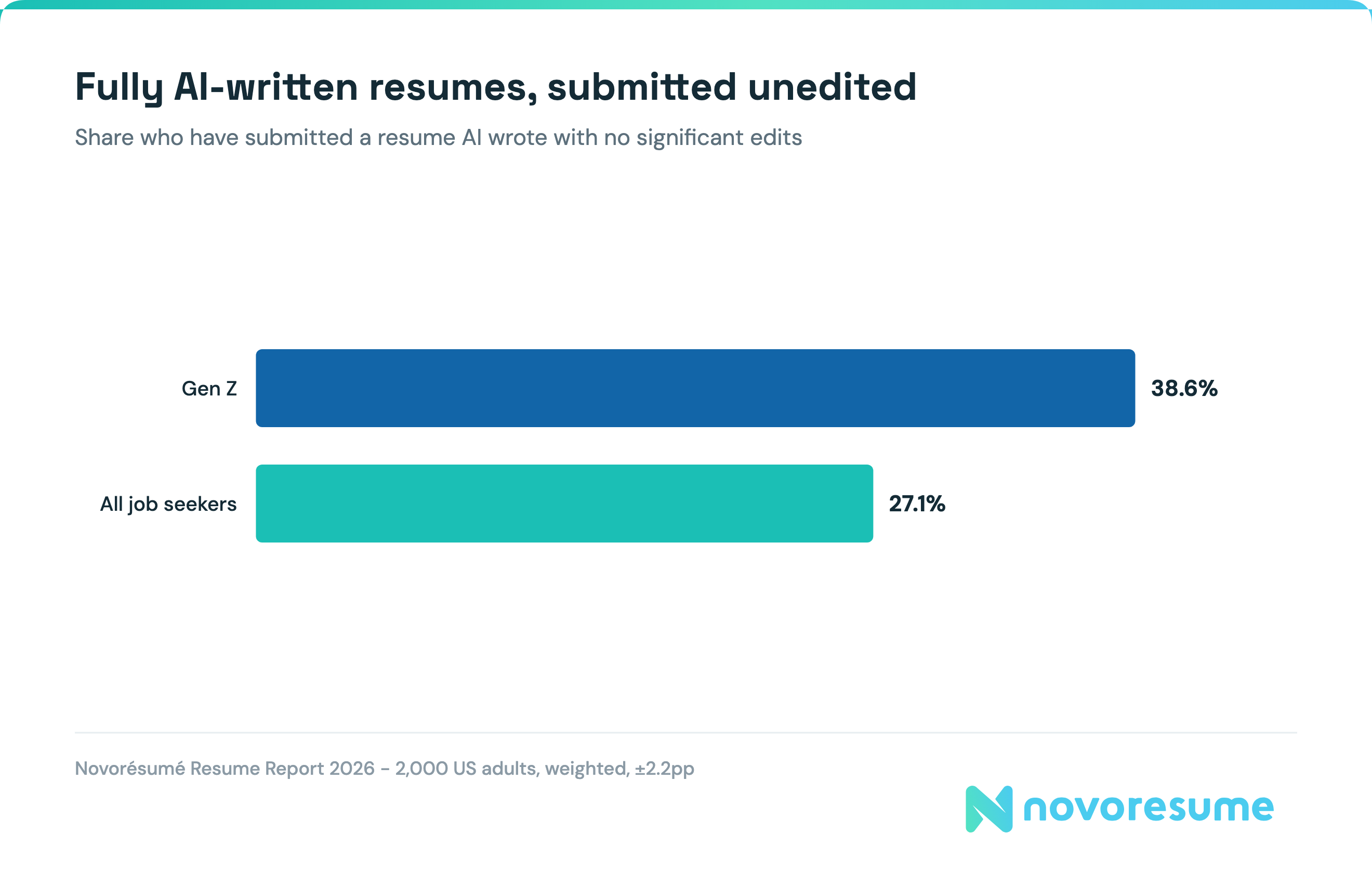
- 38.6% of Gen Z job seekers have submitted a fully AI-written resume with no significant edits, versus 27.1% of everyone.
- Median employee tenure for workers 25-34 is 2.7 years, but that's an age pattern, not a generation trait: 14% of Gen Zers are managers at age 27, the same rate as millennials, Gen X, and boomers at that age.
- Only 23% of remote-capable Gen Z workers want fully remote work, the lowest of any generation (Gallup).
- 52% of Gen Z professionals say they don't want a middle-management role, yet 76% still want senior leadership eventually (Robert Walters; Deloitte).
- Gen Z's AI mood is souring: excitement dropped 14 points in a year to 22%, and employed Gen Zers are 3x as likely to say AI's workplace risks outweigh its benefits (Gallup).
- 42% of US Gen Zers live paycheck to paycheck, and only 34% still get financial help from family, down from 46% a year earlier (Bank of America).
How Big Is Gen Z's Workforce Presence in 2026?
- Gen Z (born 1997-2012) makes up just under 20% of the US workforce, based on Glassdoor Economic Research's analysis of Current Population Survey data.
- One in ten US managers is now Gen Z (Glassdoor).
- The myth-bust hiding in that data: 14% of Gen Z workers aged 27 hold management roles, essentially identical to millennials (13%), Gen X (14%), and boomers (12%) at the same age. The generation reaches management right on schedule.
- Looking forward, Forrester projections cited by Deloitte put Gen Z and millennials at 74% of the global workforce by 2030.
How Tough Is the Entry-Level Job Market for Gen Z?
- Unemployment for recent college graduates aged 22-27 stands at 5.7%, and underemployment at 41.5% (New York Fed, Q1 2026).
- For the first time in the New York Fed's series back to 1990, recent graduates are more likely to be unemployed than the workforce as a whole.
- The AI squeeze is measurable: early-career workers (22-25) in the most AI-exposed occupations saw a 16% relative employment decline since late 2022, driven by a collapse in hiring rather than layoffs, while experienced workers in the same occupations kept growing (Brynjolfsson, Chandar & Chen, Stanford Digital Economy Lab, analyzing ADP payroll records; November 2025 revision).
- Widely quoted versions of that finding still say 13%; that was the August 2025 draft. The revised figure is 16%.
- Entry-level openings rose 18% in April 2026, but entry-level applications fell 9%, and the average role now draws 31 applicants (iCIMS platform data).
- The entry-level applicant pool is aging around Gen Z: 18-24s dropped from 44% to 40% of entry-level applicants in a year, while applicants 45+ grew to 21% (iCIMS).
- A year earlier, the squeeze was at its worst: entry-level applications up 22% year over year, 36 applicants per opening, and a 6.6% new-graduate unemployment rate, the highest in a decade outside the pandemic (iCIMS, June 2025).
- The silver lining: employers project hiring 5.6% more Class of 2026 graduates in NACE's spring update, reversing a flat-to-negative fall outlook; over a third of surveyed employers plan additional hires (NACE, surveying 185 employers).
- Sentiment hasn't caught up: 62% of Class of 2026 seniors feel pessimistic about starting their careers, up 16 points in two years, and entry-level postings on Handshake remain 12% below pre-pandemic levels.
- Bargaining power is thin: job applicants were 12% less likely to reject an offer in 2025 than in 2023, accepting roughly 3 of 4 offers, a take-what-you-can-get dynamic Glassdoor warns hits early careers hardest.
- The wider funnel Gen Z is entering: the average posting draws 244 applications, and only 7.6% of applicants pass the first interview stage (Greenhouse).
- 69% of job seekers have encountered fake or ghost job postings, and 40% of first-time job seekers have faced AI-analyzed video interviews (Greenhouse; ZipRecruiter).
How Does Gen Z Actually Apply for Jobs?
- Gen Z applies at the highest volume of any generation: 21.9 applications per search, versus 16.6 for the average job seeker and 8.9 for Boomers.
- 55.8% of Gen Z used AI the last time they updated their resume, the highest of any generation (Millennials 47.6%, Gen X 34.1%, Boomers 24.5%).
- 38.6% of Gen Z have submitted a fully AI-written resume with no significant edits, versus 27.1% of all job seekers.
- Gen Z is more than twice as likely as Boomers to have had AI generate their resume outright (18.8% vs 7.5%).
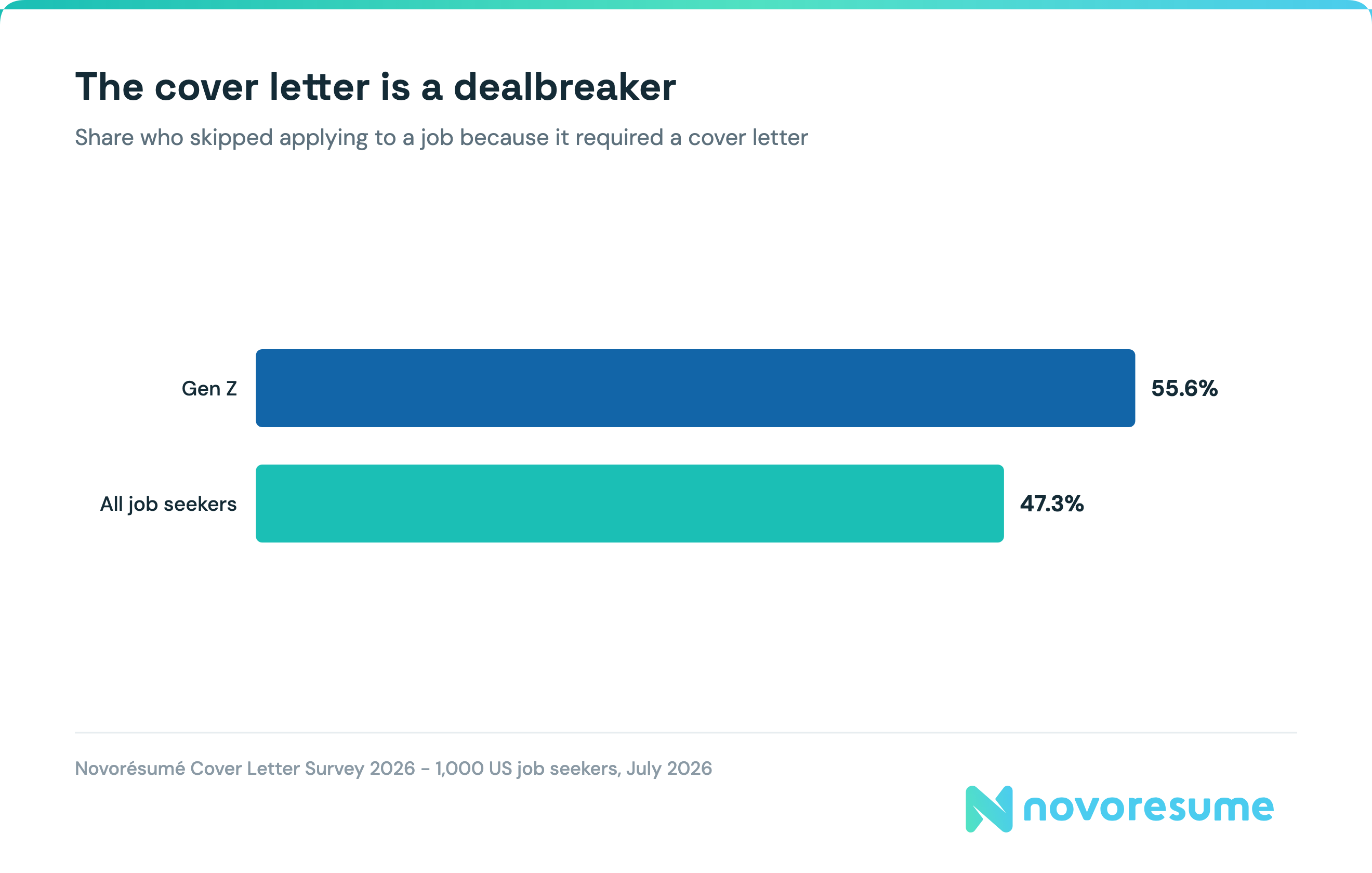
- Cover letters are a filter Gen Z refuses: 55.6% have skipped applying to a job because it required a cover letter, versus 47.3% of all job seekers, per our Cover Letter Survey 2026.
- Once hired, the AI reliance follows: 36.8% of Gen Z workers list skills on their resume or LinkedIn they can only perform with significant AI assistance, and 26.5% have been promoted at least partly on AI-created output, per our AI Workplace Audit.
- The pragmatic case for AI fluency in the search itself: frequent AI users received job offers at more than twice the rate of AI avoiders, 76% vs 33% (ZipRecruiter, Q1 2026).
- Credentials matter less than they used to: 53% of employers have eliminated degree requirements for some roles, up from 30% in 2024 (TestGorilla).
- The volume game has a quality ceiling: in our User Success Study of 914 hired users, 79% had an offer within three months of rebuilding their resume with our free resume builder, and 71% did it on the free plan.
What Does Gen Z Want From Work in 2026?
- 44% of entry-level job seekers name job security a top factor when evaluating roles, and only 19% feel very confident about their careers (iCIMS, surveying 1,000 US job seekers).
- Their top process complaint is silence: 48% say never hearing back after applying is their biggest frustration (iCIMS).
- Culture is the retention lever: 94% of professionals say workplace culture affects their decision to stay (EY, surveying 5,000 US white-collar workers).
- The counterintuitive one: only 57% of Gen Z rank pay as a top factor, versus 74% of other generations (EY).
- 48% of Gen Z want an employer whose values reflect their own, and 41% feel their employer invests in their growth, the highest of any generation (EY).
- Pay transparency became table stakes: 77% of full-time jobs posted to Gen Z on Handshake in 2025 included salary information, and the median posted salary rose to $67,500.
- Purpose is non-negotiable: 89% of Gen Z say a sense of purpose is important to their job satisfaction and wellbeing (Deloitte, surveying 23,482 respondents across 44 countries).
- The remote-work stereotype is backward: only 23% of remote-capable Gen Z employees prefer fully remote work, versus 35% in every older generation (Gallup, surveying 19,043 US workers).
- Behavior matches: just 12% of students using Handshake's work-arrangement filters searched exclusively for remote jobs.
- What they want from the boss is coaching: 50% of Gen Z name mentoring a top thing they want from their manager, but only 36% say they actually get it (Deloitte).
Is Gen Z Really Job-Hopping More Than Other Generations Did?
- Median employee tenure for workers 25-34 is 2.7 years, versus 9.6 years for workers 55-64 (Bureau of Labor Statistics, Employee Tenure in 2024).
- For workers 20-24, median tenure is 1.2 years, and roughly half have been with their employer a year or less (BLS).
- Overall US median tenure fell to 3.9 years, the lowest since 2002, so the whole labor market is getting shorter-tenured, not just its youngest members (BLS).
- The BLS has recorded the same young-workers-move-more pattern in every tenure survey since 1996. Combine that with the management-parity data above (14% at age 27, same as every generation) and the "disloyal generation" story collapses into "young people, as always."
- Intent tracks the market, not the generation: 51% of all US workers are watching for or actively seeking a new job (Gallup), and changing careers remains a whole-workforce phenomenon.
How Is Gen Z Using AI at Work?
- 74% of Gen Z use AI daily at work, up from 57% a year earlier (Deloitte, 2026).
- AI has become Gen Z's career department: 79% use it to identify learning opportunities, 72% ask it for career advice, and 67% use it to cope with work-related stress (Deloitte).
- The cost shows: 58% of Gen Z report digital fatigue (Deloitte).
- The mood is turning anyway: among Gen Zers aged 14-29, excitement about AI fell 14 points in a year to 22%, anger rose 9 points to 31%, and anxiety holds at 42% (Gallup, with the Walton Family Foundation, surveying 1,572 Gen Zers, February-March 2026 fieldwork).
- Employed Gen Zers are 3 times as likely to say AI's workplace risks outweigh its benefits: 48% vs 15% (Gallup).
- They see both edges: 20% of Gen Z say their organization is scaling back entry-level roles because of AI, while about 23% say AI is creating new entry-level positions (Deloitte).
- 85% of Class of 2026 seniors use AI tools, up 31 points in two years, and over a third use them daily (Handshake).
- Despite using AI so heavily, there is an obvious training gap: 58% of seniors say they'll need stronger AI skills to succeed, but only 28% say their program meaningfully integrated AI (Handshake).
- Demand agrees: the share of full-time postings on Handshake mentioning AI nearly doubled in a year to 4.2%, and over 10% of internships now mention it.
- Everyone brings their own tools: 85% of Gen Z AI users bring personal AI tools to work, but so do 78% of millennials, 76% of Gen X, and 73% of boomers (Microsoft and LinkedIn, Work Trend Index, 2024). The AI-native label describes a head start, not a monopoly.
- Young workers lead chatbot use at work (23% of 18-29s use them at least a few times monthly), while 52% of all workers are worried about AI's future role in their workplace (Pew Research Center, October 2024 fieldwork).
Do Managers and Gen Z Actually Clash?
- The most-quoted numbers in this genre ("74% of managers find Gen Z hardest to work with," "6 in 10 employers already fired their new grads") come from PR polls with undisclosed methodology, run by content-marketing operations. No rigorous study backs them.
- What a disclosed-methodology study finds instead: 79.7% of graduating seniors rate themselves very proficient in professionalism; only 50.3% of employers rate new grads that way (NACE, surveying 20,482 students and 237 employers).
- The same perception chasm runs through communication (78.1% self-rated vs 53.5% employer-rated), critical thinking (80.8% vs 55.9%), and leadership (66.0% vs 31.0%).
- It's not one-directional: on technology proficiency, employers rate new grads higher than the grads rate themselves (72.0% vs 60.5%), and on teamwork the two sides agree almost exactly (83.5% vs 81.5%) (NACE).
- The friction, measured soberly: 35% of US employees say age or generational differences contributed to workplace incivility they witnessed or experienced (SHRM Civility Index).
- Gen Z knows where it's short and is buying the missing skills: 99% worked on professional skills development in the past year, and they out-invest millennials in emotional intelligence training (43% vs 32%) (EY). The soft skills gap is real, but it's being worked on.
Does Gen Z Want to Manage Anyone?
- 52% of Gen Z professionals say they don't want a middle-management role, and 69% call middle management "too high stress, low reward" (Robert Walters, the UK poll that coined "conscious unbossing").
- 72% would choose an individual-contributor route over managing others if offered the choice (Robert Walters).
- The rigorous version is starker: only 6% of Gen Z name reaching a leadership position as their primary career goal (Deloitte).
- But the ambition isn't dead; it's just rescheduled: 76% of Gen Z still express interest in reaching senior leadership eventually, more than millennials at 67% (Deloitte).
- The route is deliberately slower: 44% prefer steady progress, and 21% would even move laterally or backward; the barriers they name are stress and burnout (50%), excessive responsibility (50%), and work-life balance worries (41%) (Deloitte).
- Meanwhile, employers still believe in the layer Gen Z is refusing: 89% say middle managers are crucial to their organization (Robert Walters).
How Is Gen Z Doing With Money?
- 42% of US Gen Z live paycheck to paycheck (Bank of America, surveying 1,133 Gen Z adults, February 2026 fieldwork).
- The parental subsidy is ending fast: 34% receive financial help from family, down from 46% a year earlier; among 26-29s it's just 18% (Bank of America).
- The counterweight: 66% of Gen Z are actively saving, up from 60% (Bank of America).
- Globally, 48% of Gen Z don't feel financially secure, an 18-point jump in one year, and about a quarter question whether their degree was worth it (Deloitte).
- Side hustles skew hard to this generation: 57% of Gen Z employees have one, versus 39% of all employees (Glassdoor-commissioned Harris Poll).
- Money now steers the career itself: 69% of Gen Z say housing affordability affects their career decisions, and 55% have delayed major life decisions over finances (Deloitte).
- The genuinely hopeful number: after early-career real wages fell 4.1% below 2020 levels by 2022, wage growth has outpaced inflation since 2023, and 2026 is projected as the first year early-career purchasing power exceeds pre-pandemic levels (Glassdoor Economic Research).
- Optimism is intact: 53% of Gen Z expect their personal finances to improve within a year (Deloitte).
How Is Gen Z Feeling at Work?
- Gen Z is the loneliest cohort in the workplace: 45% of workers aged 18-25 feel lonely on the job, versus 33% of 26-43s and 14% of 65+ (American Psychological Association, 2024 Work in America survey).
- 48% of 18-25s typically feel tense or stressed during the workday, nearly 3 times the rate of the oldest workers (APA, 2024).
- 48% believe older colleagues don't see the value in their ideas, and 62% feel more comfortable with same-age colleagues (APA, 2024).
- Engagement is falling fastest among them: Gen Z employees were 5 points less engaged year over year in Gallup's 10-year-low reading, with the biggest drops in feeling cared about, recognition, and development opportunities.
- Only 57.4% of workers under 25 are satisfied with their jobs, versus 72.4% of workers 55+, and under-25s were the only age group to decline (The Conference Board).
- The mental-health throughline: half of Gen Z cite stress and burnout as a reason to avoid leadership roles, and 67% already use AI to cope with work stress (Deloitte).
Methodology
- Our 2026 Resume Report: 2,000 US adults aged 18-64, surveyed May 2026 via Pollfish, census-weighted, margin of error ±2.2 percentage points. Generational cuts use Pew's birth-year definitions.
- Our Cover Letter Survey 2026: 1,000 US job seekers aged 18-64, surveyed July 2026 via Pollfish across two waves.
- Our AI Workplace Audit: 1,000 US full-time workers, surveyed February 2026 via Pollfish, census-balanced.
Sources
External sources, cited inline:
Sources
- Federal Reserve Bank of New York, The Labor Market for Recent College Graduates, Q1 2026
- Brynjolfsson, Chandar & Chen (Stanford Digital Economy Lab), Canaries in the Coal Mine (ADP payroll data), November 2025 revision
- Glassdoor Economic Research, Worklife Trends 2025 (CPS/IPUMS analysis) and Worklife Trends 2026 editions
- iCIMS Insights Workforce Reports, June 2025 and May 2026 (platform data + 1,000 US job seekers)
- NACE, Job Outlook 2026 Spring Update (185 employers), April 2026; competency perception gap research (20,482 students; 237 employers), January 2025
- Handshake Network Trends, Class of 2026 report and Gen Z hiring trends 2026 (platform data + senior surveys)
- Deloitte, Global Gen Z and Millennial Survey, 2025 (23,482 respondents) and 2026 (22,595 respondents) editions
- Gallup: remote-work preferences (19,043 US workers), July 2025; US engagement 10-year low (79,087 workers), January 2025; Gen Z AI survey with the Walton Family Foundation (1,572 Gen Zers), April 2026
- US Bureau of Labor Statistics, Employee Tenure in 2024, September 2024
- EY, 2025 US Generation Survey (5,000 US white-collar workers), December 2025
- Bank of America, Better Money Habits Gen Z study (2,279 respondents), May 2026
- American Psychological Association, 2024 Work in America survey (2,027 workers)
- Pew Research Center, US workers and AI (5,273 workers), February 2025
- Microsoft & LinkedIn, Work Trend Index (31,000 workers, 31 countries), 2024
- SHRM, Civility Index, Q1 2025
- Robert Walters, conscious unbossing poll (UK professionals), September 2024
- The Conference Board, Job Satisfaction 2025
- Greenhouse, 2025 AI in Hiring Report and Hire Standard Benchmark Report; ZipRecruiter Economic Research, Q1 2026; TestGorilla, State of Skills-Based Hiring 2025
 Add Novorésumé as a preferred source on Google
Get more resume writing tips, career insights, and job search advice in your personalized Google search results.
Related posts

Words and adjectives to describe yourself in interviews, on your resume, and in bios. Grouped by trait, with worked answers and the 10 words to avoid.

100+ AI hiring statistics for 2026: employer adoption, AI resumes and cover letters, interview cheating, and detection rates, from our four 2026 surveys.

80+ job interview statistics for 2026: AI interviews, funnel odds, ghosting, and offer rates. From our own 2026 surveys plus 17 verified primary sources.