
"Highly recommended for CV templates and tips. I was amazed by how much help and content you could get for free on Novoresume. You guys saved me a lot of time and made my CV look better than ever, thanks."
Academic CV Templates
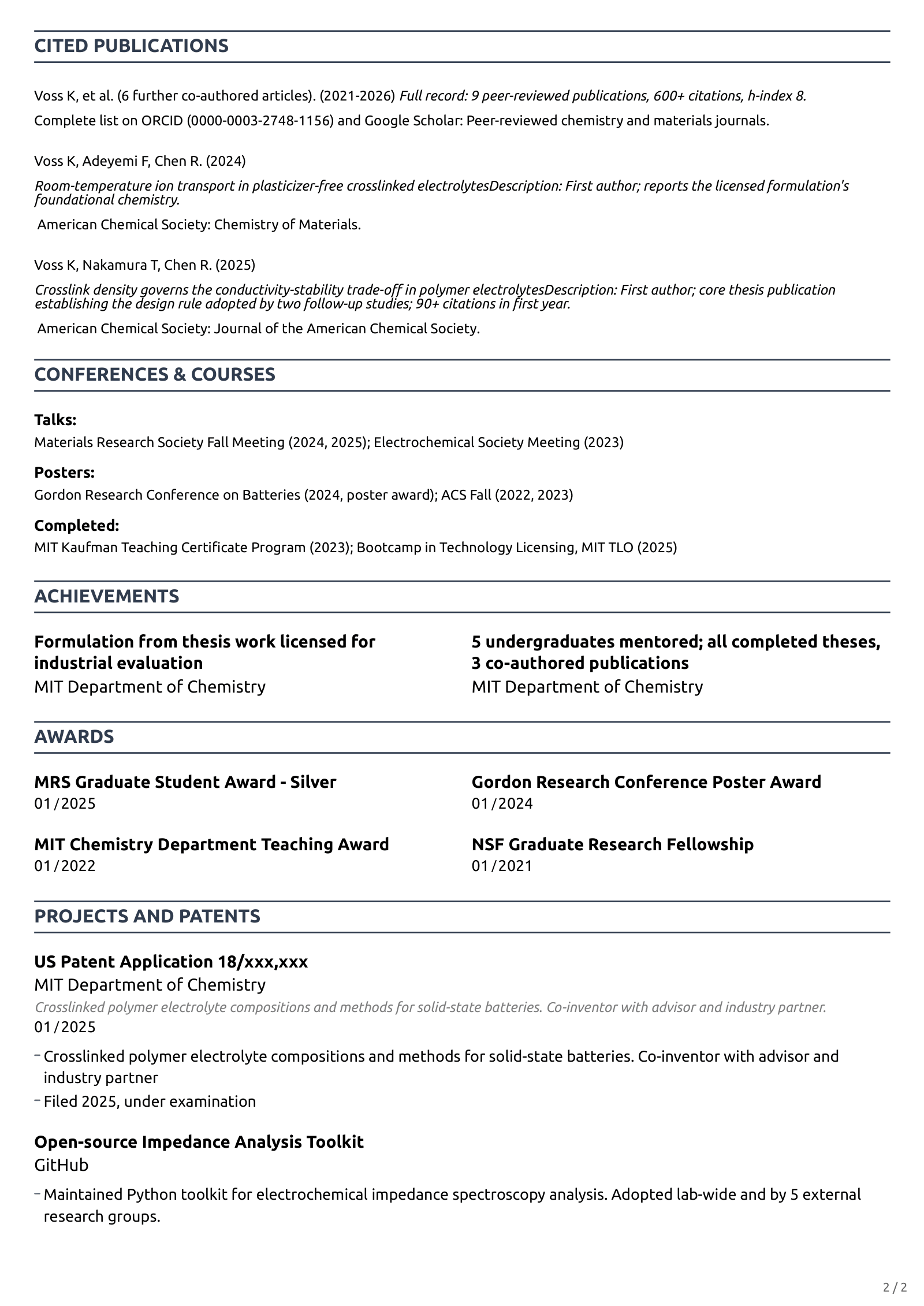
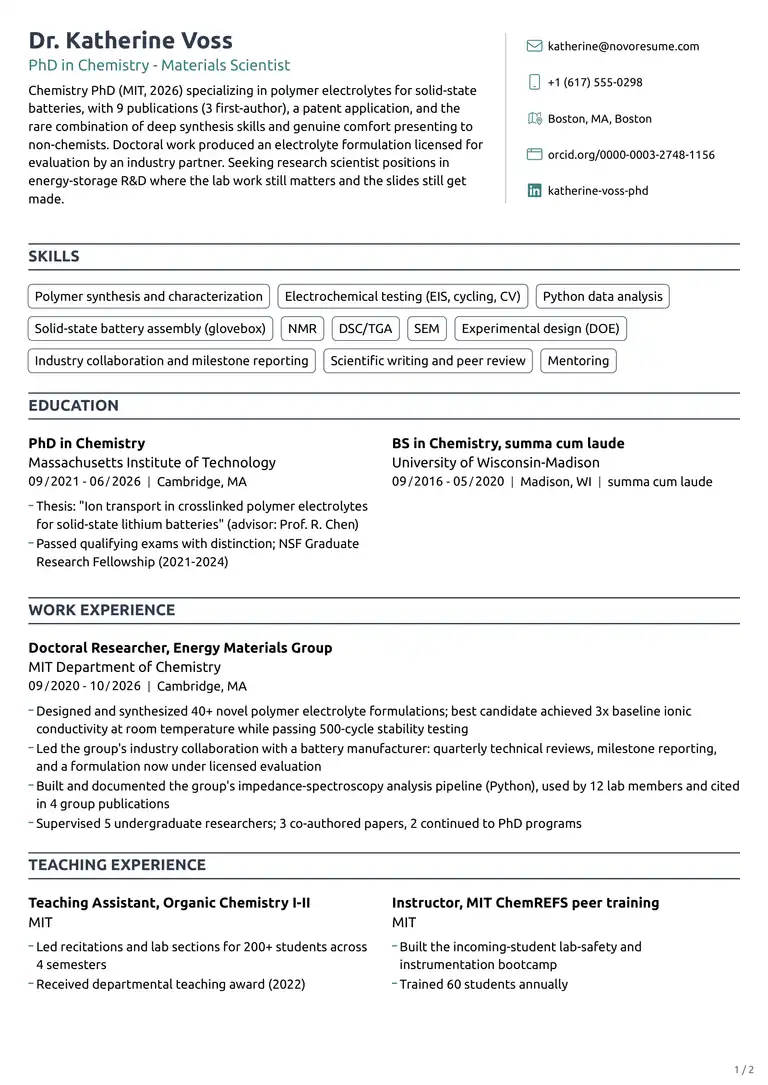
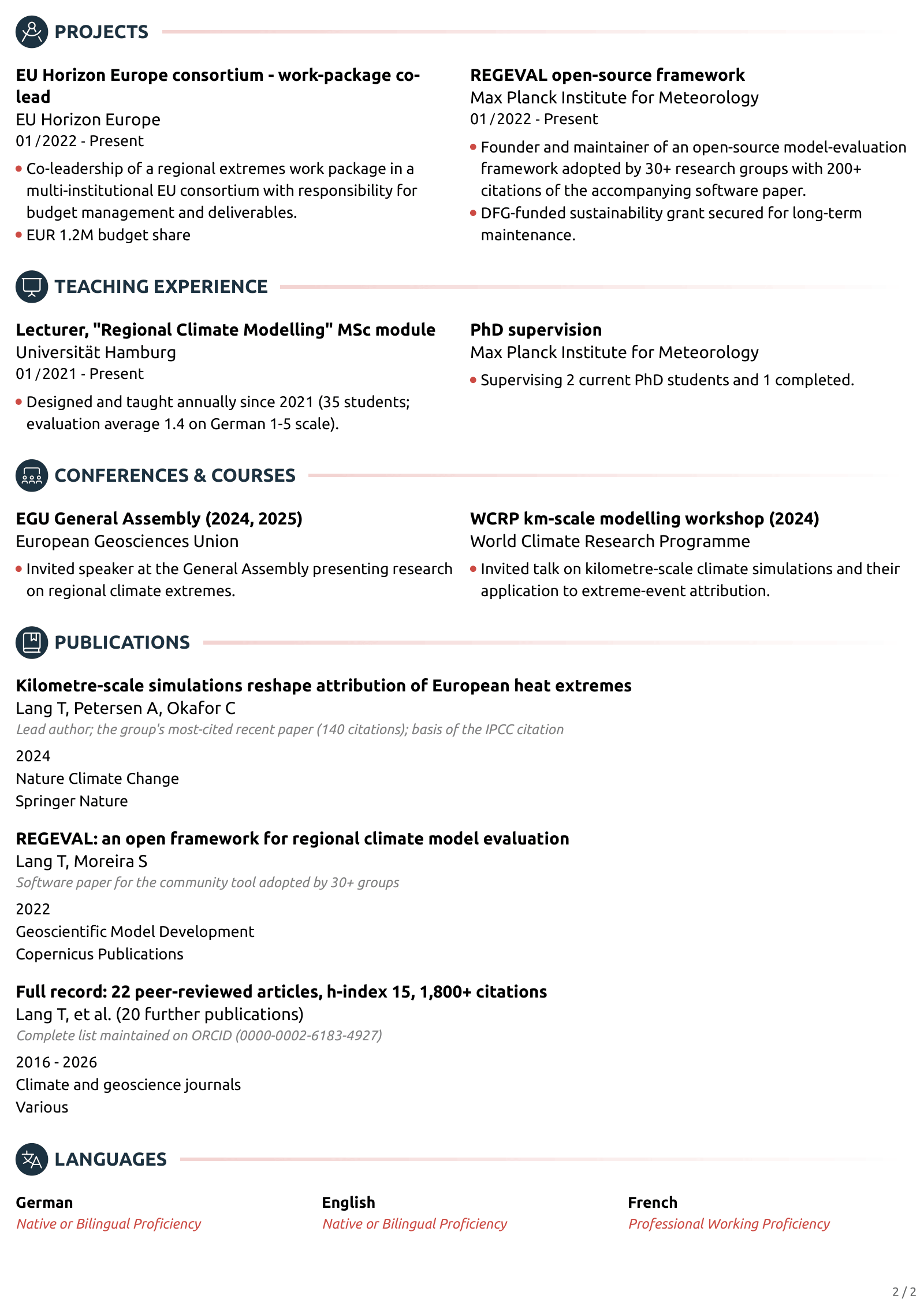
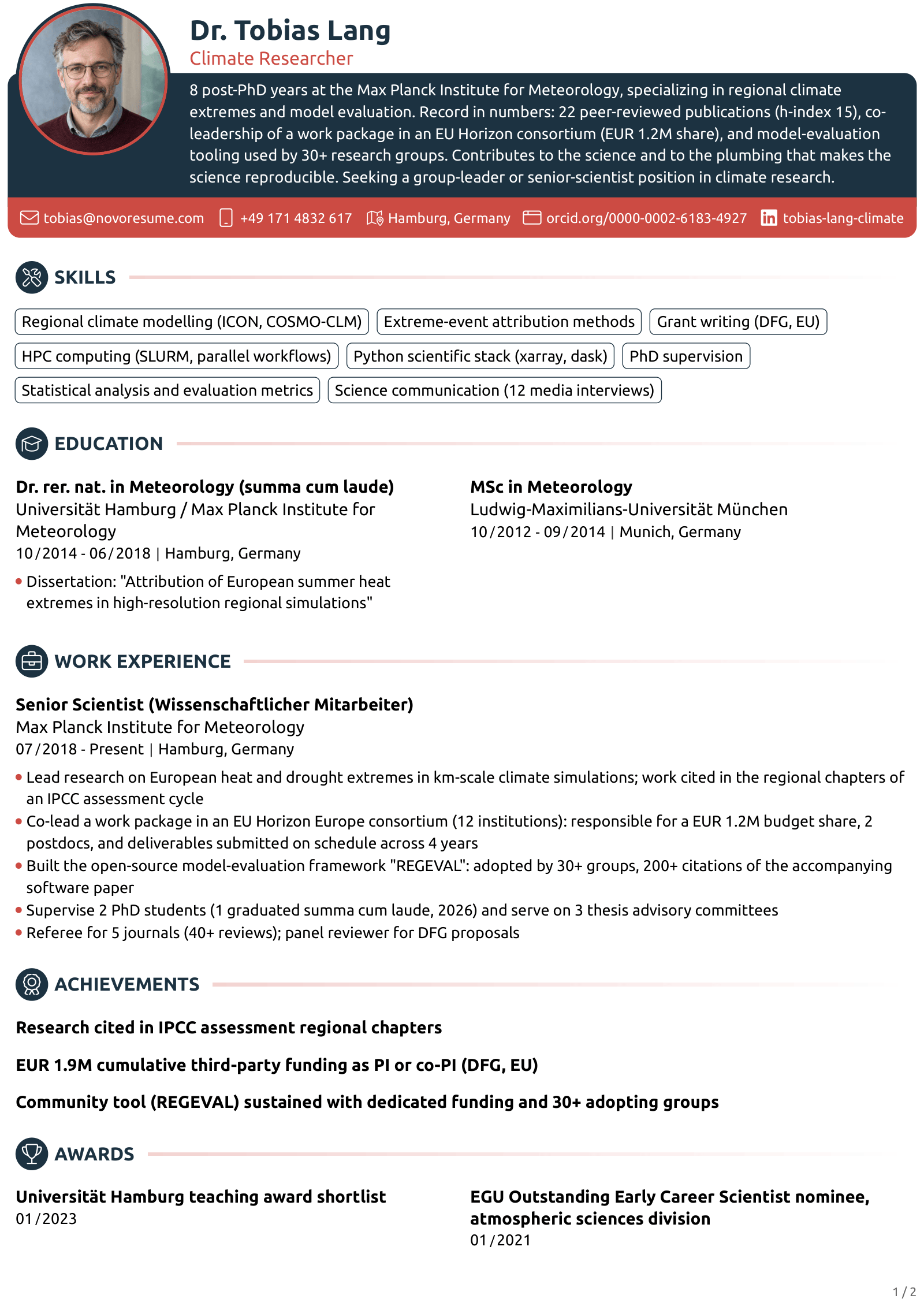
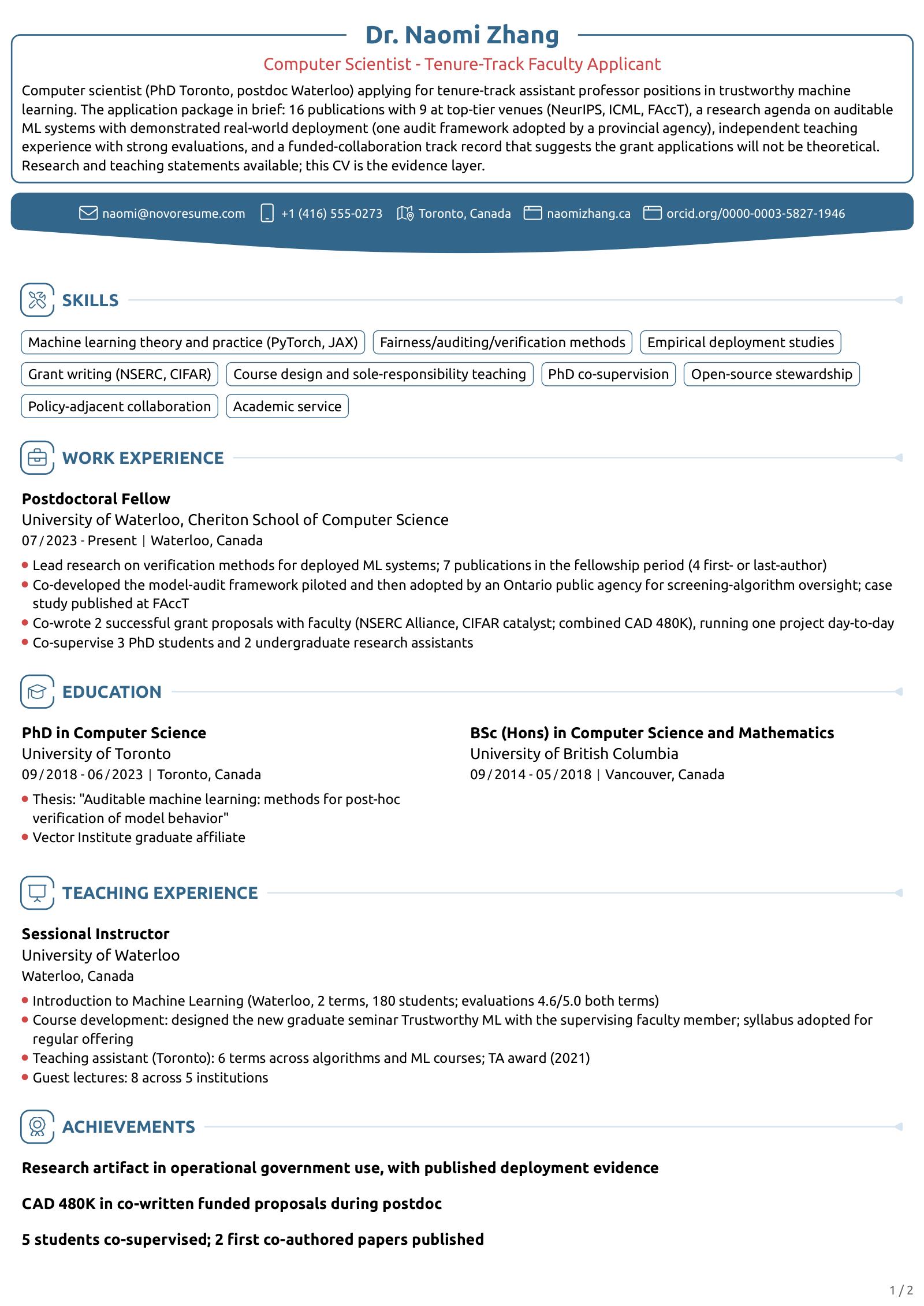
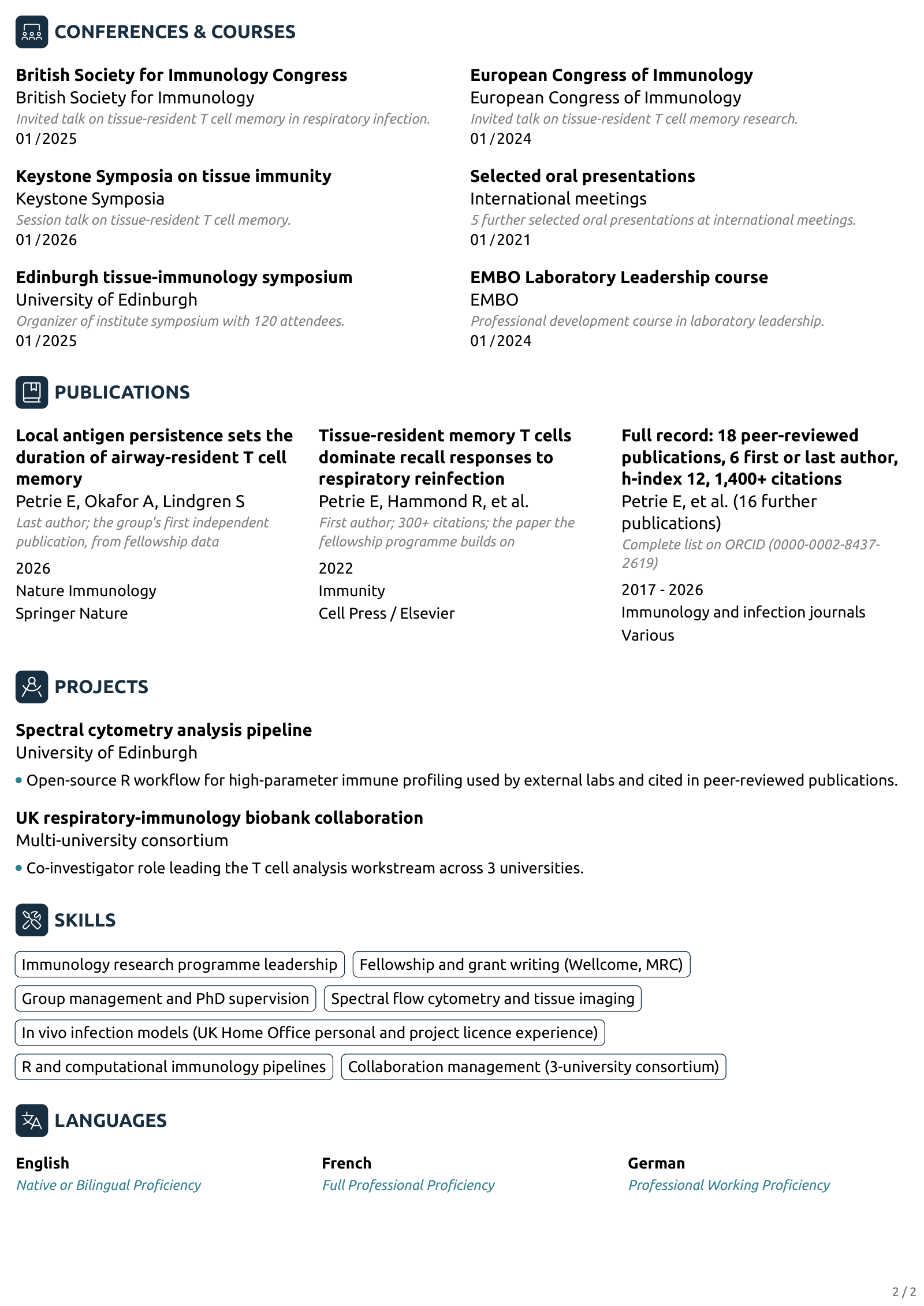
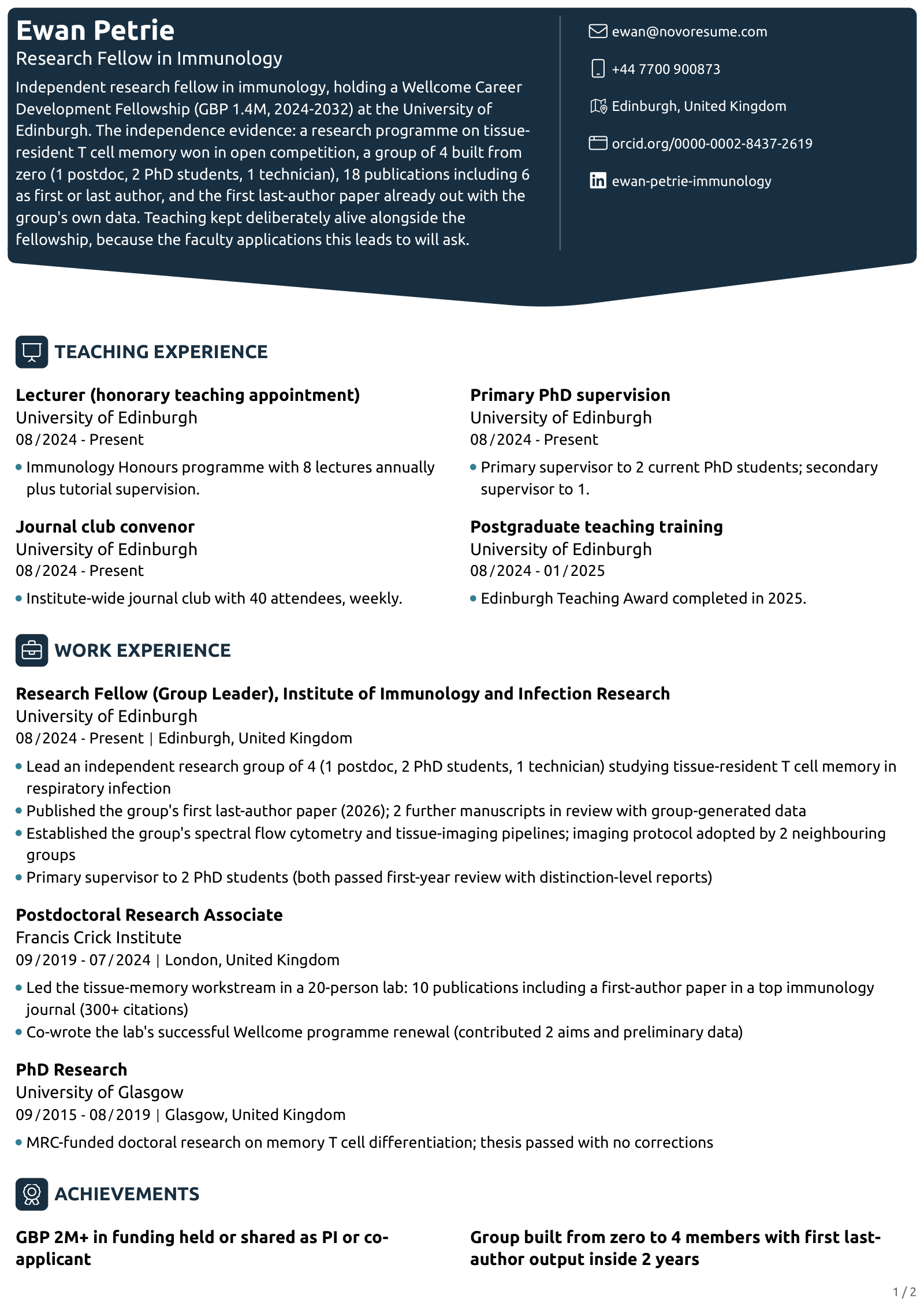
Academic CV templates with dedicated space for publications, grants, and teaching. Structure that holds across every page of your research career.
Create My CV
Free to start. No credit card required.
Import CV
- Rated Excellent on Trustpilot
- Free to start
- Print-ready A4
Novoresume got people hired at
























82.3%
of recruiters use an ATS to screen candidates (HR Survey)
74%
spend 20 seconds or less on the first scan (HR Survey)
8 in 10
users who switched from Canva, Word or Google templates, or another builder rate Novoresume 4 or 5 stars (User Success Survey)
What Does an Academic CV Include?
An academic CV is a complete record of your scholarly career: education, research experience, publications, grants and funding, teaching, conference presentations, awards, and professional memberships. Unlike a standard CV, it has no length limit. The committee expects the full picture, organised in the order your target post values most.
That order shifts as your career progresses:
Section
Education
Research experience
Publications
Teaching
Grants and awards
Early career (PhD, postdoc)
At the top, right after contact details
High up, led by your strongest projects
Everything relevant, with statuses clearly labelled
Seminars, TA work, guest lectures
Scholarships, travel grants, small funds
Established (faculty)
Below research and appointments
Leads the CV as academic appointments
Peer-reviewed work first; can run for pages
Full courses, curriculum design, supervision
Major funding bodies, with amounts
What Recruiters Say About These CV Templates
Top working recruiters, executive career coaches, and certified CV writers independently reviewed Novoresume. Here's what the people on the other side of the hiring desk said.
From a recruiter's perspective, this matters: an academic hiring committee expects to see a full research history, and cramming that into a 1-2 page CV format could work against you.
 Alison Webb Lawrence
I highly recommend Novorésumé's CV library to any job seeker who wants a template that feels right to them, appeals to recruiters, stands up to ATS parsing, and does justice to their experience and skills.
 Christy Morgan
This separation appears to reflect differences in career length and regional conventions, which makes sense in principle, though the distinction isn't immediately obvious to a new user.
 Arianna Berchicci
Who Are Academic CV Templates For?
PhD and master's candidates, postdoctoral researchers, lecturers, and faculty applicants. They also suit anyone applying for research fellowships, grants, or university teaching posts, where a committee expects the traditional academic structure rather than a corporate resume.
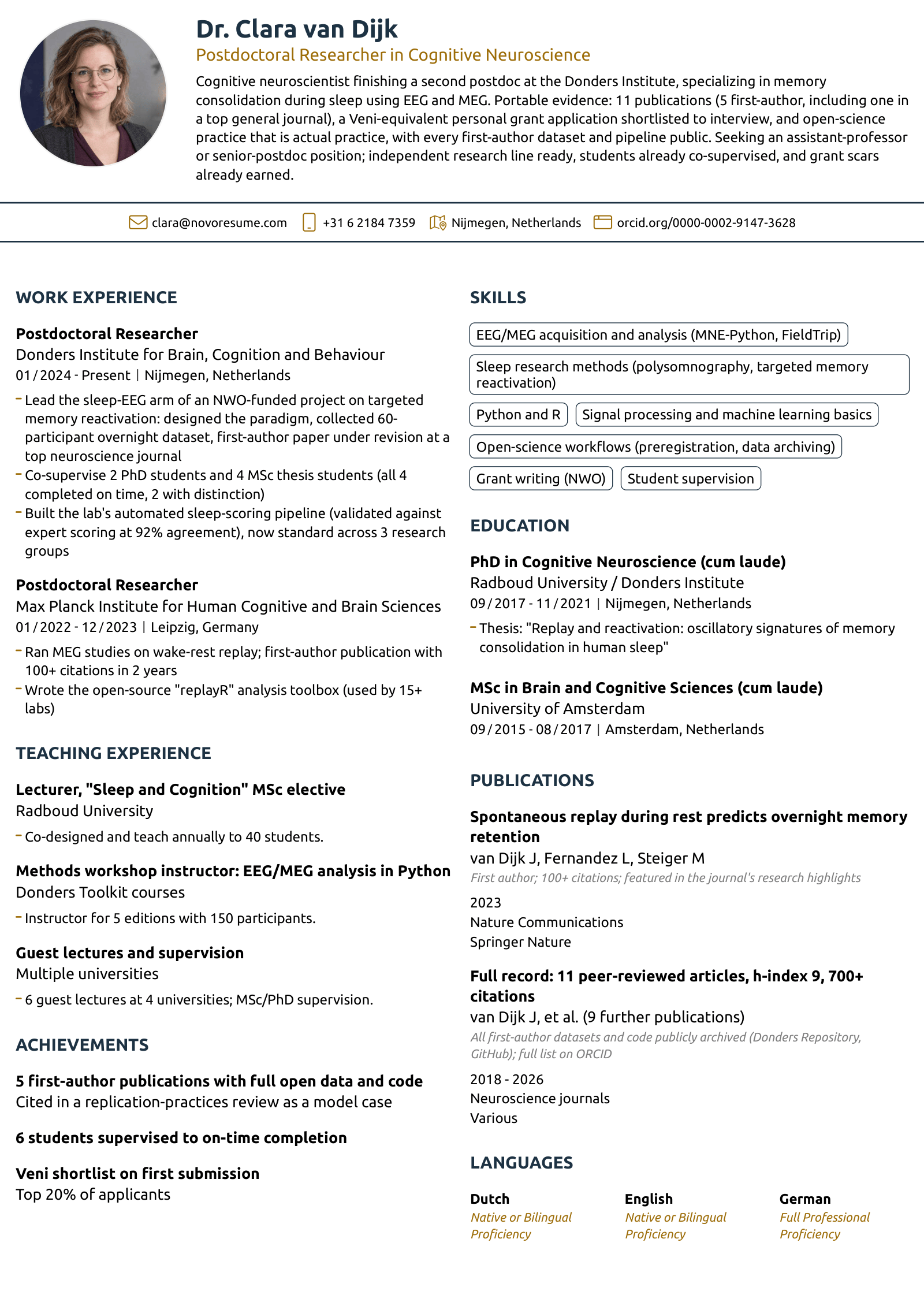
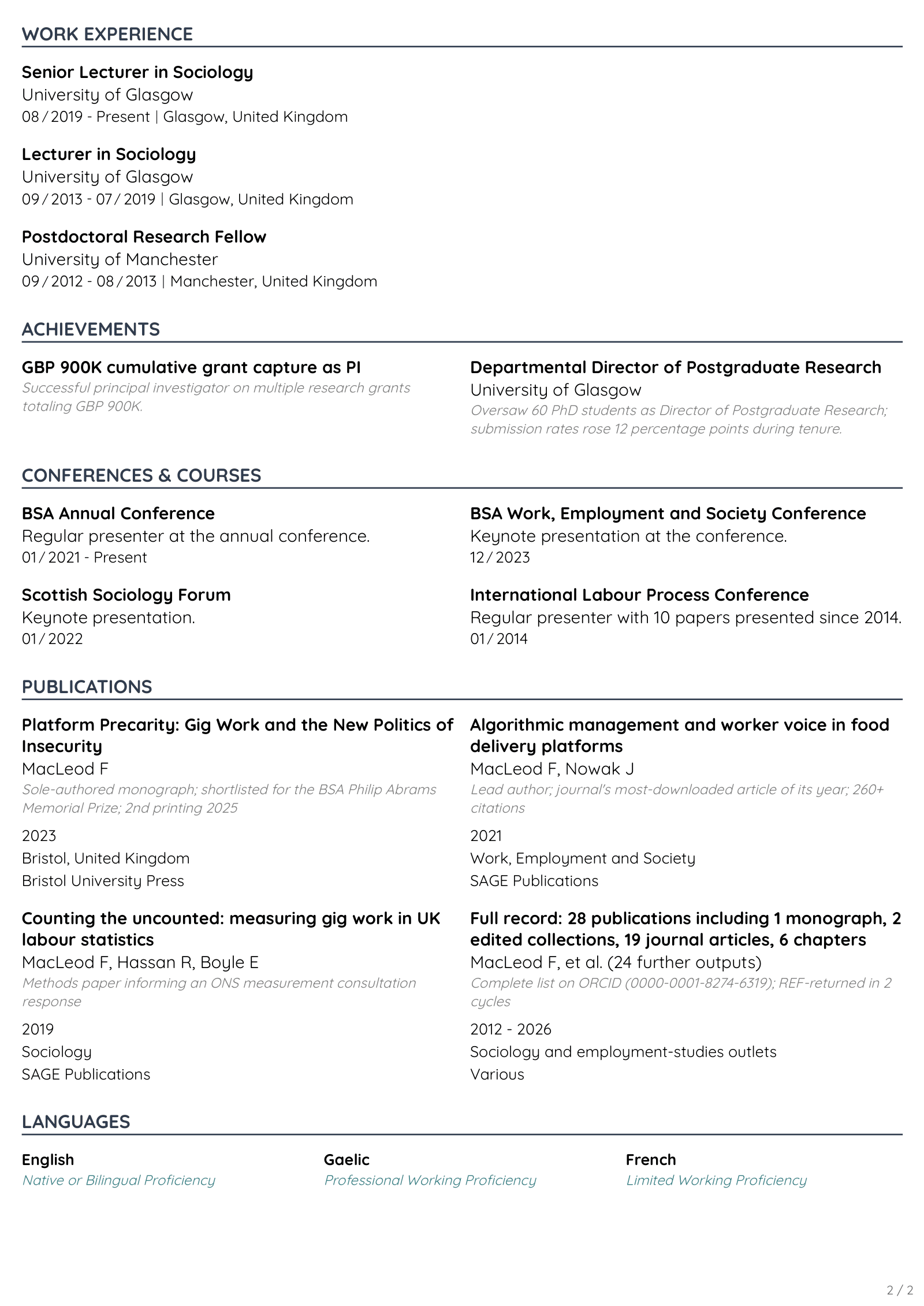
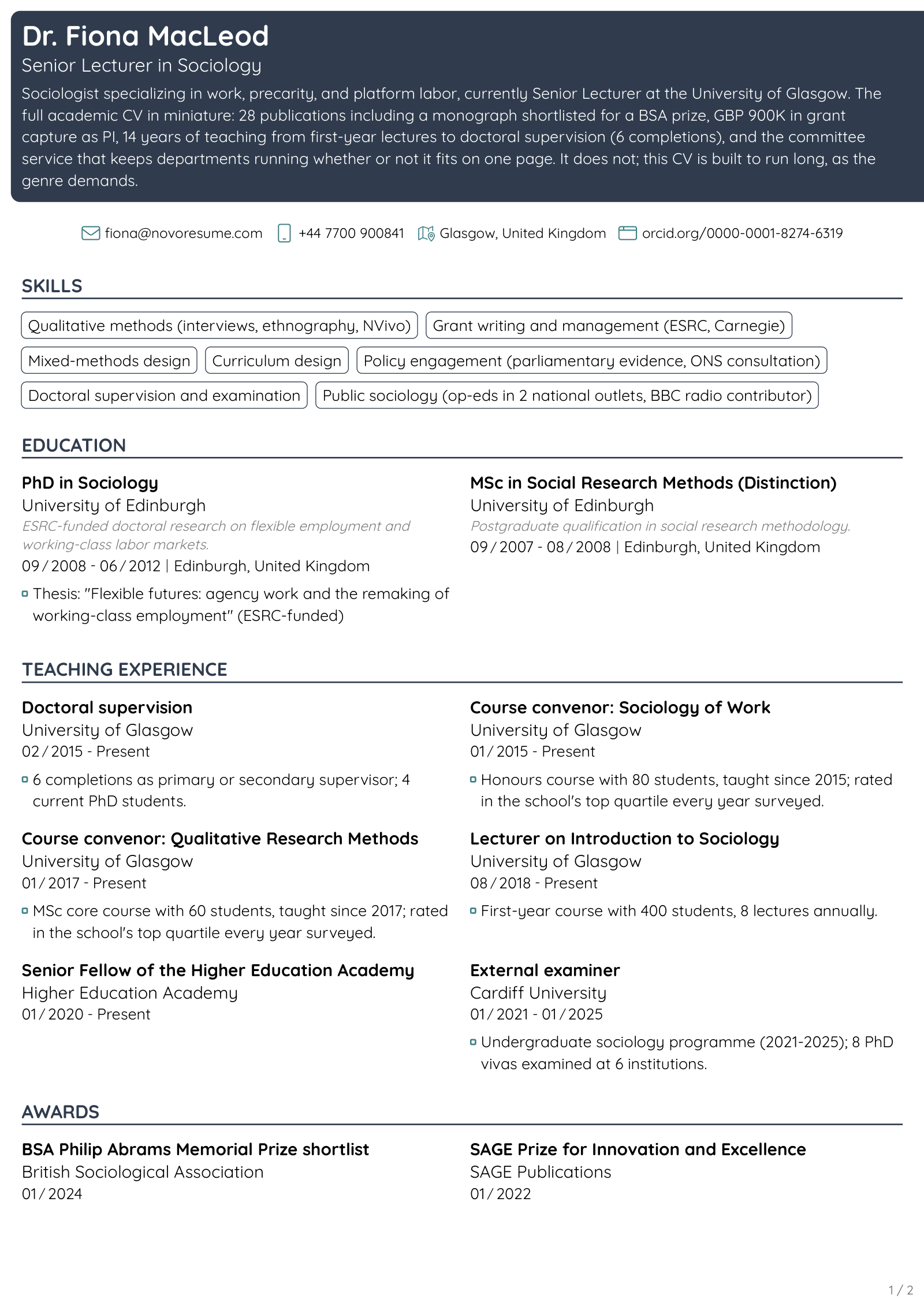
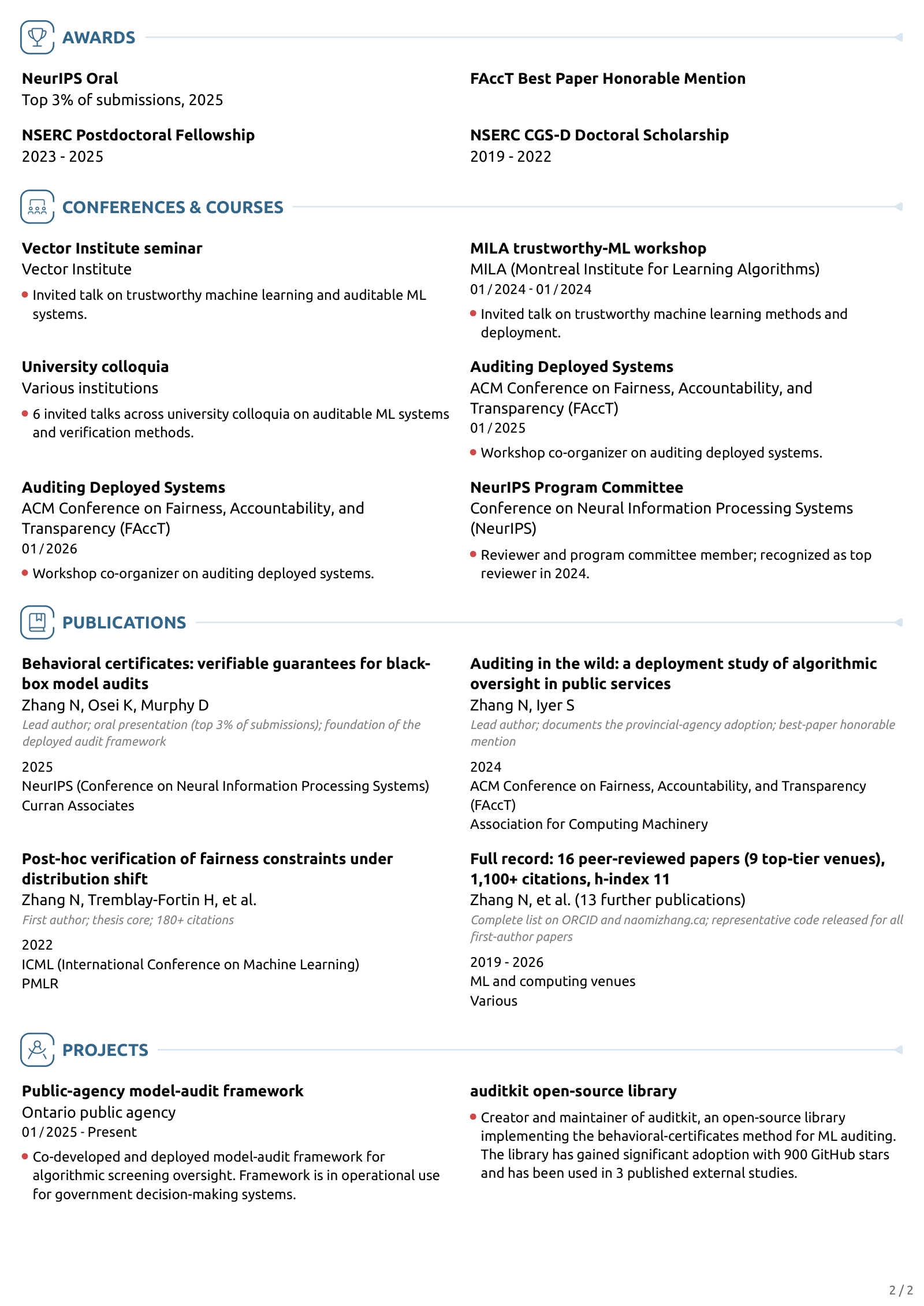
Academic CVs fail in a specific way: the record is strong, but the committee can't navigate it. We built these templates to hold ten pages as cleanly as two, so publications, grants, and teaching each keep a stable structure that doesn't collapse as your record grows. Committees know exactly where to look, because everything sits where convention says it should.
Build My CV Now
79% of users who rebuilt their CV received a job offer within 3 months, per our User Success Survey
Pros and Cons of Academic CV Templates
Pros
- Dedicated sections for publications, grants, teaching, and conference work: exactly what committees read for.
- Structure stays consistent three or four pages in, where self-built documents drift.
- Publication fields separate title, authors, publisher, and date, so nothing gets buried in a paragraph.
- Sections reorder as your career stage shifts: education-first early on, appointments-first once established.
Cons
- Overkill for industry applications, where a 1-2 page CV wins; keep a short version for those.
- Length invites padding, and committees notice filler faster than gaps.
- Minimal visual differentiation by design, since committees read for substance, not styling.
What job seekers say
"Templates available here helped to organise my 15 years of experience in just 1 page. My CV got shortlisted wherever I applied (Facebook, Google, Amazon, Akamai, Microsoft and Expedia). I finally landed with a job offer at 2 companies from this list."
"Just awesome. Intuitive, with great UX/UI in general and flexible. Takes very little time to create a well-designed CV. Tips on how to improve your CV based on the input is a great tool too. The free tier is more than enough to create a great, clean CV."
"Amazing platform for all levels of your professional career. Great platform with good templates. It also provides some insights on CV building and makes it easy to format the document, leaving you some space to focus on what really matters: your content."
"Novoresume has enabled many individuals to have access to a constructive CV and well-detailed cover letter and guess what? It is free. Thank you!"
"I've had a tremendous experience in Novoresume when building my CV. This platform doesn't compare to any other in their field! Thanks for giving us the opportunity to have a world-class quality CV!"
"Professional and attractive CV design that is easy to complete at an accessible cost. The storage of your information also makes customising my CV for each application a breeze."
"Marvellous! I have successfully gained multiple nursing positions with my CV and cover letter via Novoresume.com!"
"Excellent platform for making CVs. I was able to make multiple CVs that suited many jobs. I love the layout and the proofreading options."
"Using Novoresume makes CV creation easier than before with all the templates and suggestions, even the recommendations that they give while creating a competitive CV helps us to get hired and outstand in the field."
"An awesome, great and flexible service. You can build your CV and cover letter in a short time with lots of tips that improve your skills."
"Best CV and cover letter templates I have seen so far."
Frequently Asked Questions
How long should an academic CV be?
There's no fixed limit on academic CVs. Early-career researchers often run two to four pages, while established academics with long publication lists can run much longer. The rule is completeness over brevity: include everything relevant and let the document be as long as your record requires. Committees skim before they read closely, so invest in navigability rather than compression: consistent headings, reverse-chronological order within every section, and page numbers with your surname in the footer, since long CVs get printed, shuffled, and passed around a panel.
What sections should an academic CV include, and in what order?
The standard reverse-chronological sequence is: 1. Contact details 2. Research interests 3. Education 4. Research experience 5. Publications 6. Teaching experience 7. Conference presentations 8. Grants and awards 9. Professional service and memberships Order by what the post values most: lead with research for research-heavy roles and teaching for teaching-focused ones. Early-career applicants usually keep education near the top, since it carries weight before a full publication record exists. Whatever the order, keep it consistent: the same date format, the same citation style, and the same heading hierarchy from the first page to the last.
What's the difference between an academic CV and a resume?
A resume is a short, tailored document focused on a specific job, usually one to two pages. An academic CV is comprehensive and covers your entire scholarly career, including publications, grants, and teaching. Academia, research, and medicine use the CV; most other sectors use the shorter resume. If you're applying to both academic posts and industry roles, maintain both documents in parallel: the CV as the complete record you update continuously, and a short resume you cut down from it for each application.
How do I write an academic CV with no publications yet?
A publication record isn't expected early on, so lead with your education, any master's or undergraduate research, technical and language skills, and any posters or conference participation. Show research potential rather than output, and add a short personal statement to surface transferable strengths. A first academic CV of two pages is completely normal. Committees reviewing early-career applications read for trajectory, not volume: a mastered method, a poster at a national conference, or a research assistantship all count as evidence that you'll produce.
How do I list publications that aren't published yet?
Use clear status labels: "under review," "in preparation," or "forthcoming," and name the target journal where you can. Keep "in preparation" to one or two papers that are genuinely close to submission, since padding this section is obvious to reviewers. List peer-reviewed work first and separately, and use your field's standard citation style throughout. Update the statuses before every single application; a stale "under review" from two years ago raises more questions than it answers, and academia is small enough that people check.
Should I include teaching experience on an academic CV?
Yes, if you have it. Teaching experience signals you can contribute beyond research, which matters for most faculty and lecturer posts. List the courses you've held, your role, the institution, and the level taught, and place the section prominently if the post is teaching-focused. Where you can, add scale and evidence: cohort sizes, course evaluation scores, or materials you designed. "Taught a 120-student introductory module, rated 4.6/5 in evaluations" carries far more weight than a bare course title.
Should I list references on an academic CV?
Usually yes, which is a key difference from a standard resume. Most academic candidates list three referees directly, with each person's name, title, department, institution, and contact details, placed at the end. Confirm every referee has agreed before you include them. Choose people who can speak to different parts of your record, typically your supervisor, a collaborator, and someone who has seen your teaching. Seniority helps, but a referee who knows your work in detail beats a famous name who barely remembers you.
Do you put a photo on an academic CV?
No. UK and US academic hiring excludes photos, and committees don't expect them. Parts of continental Europe differ, so check the institution's norms if you're applying there, but when in doubt, leave it off. The only real exception is an application system that explicitly requests one; otherwise, every centimetre of the page is better spent on your record, which is the only thing the committee is scoring.
How do I adapt an academic CV for industry jobs?
Compress, don't copy. Industry recruiters want one to two pages, so select your most relevant publications, translate research into outcomes and methods ("built a data pipeline processing 2M records," not just the paper title), and lead with skills and tools the role names. Keep the full academic CV for academic applications. Industry applications also pass through applicant tracking systems, so mirror the language of the job description rather than the language of your subfield: "statistical modelling in R" matches a data role's search, while your paper's full title matches nothing.
Do academic applications go through an ATS?
Often, yes. Many universities collect applications through portals like Interfolio or Workday, which parse your CV before the committee reads it. Committees still read the full document, but clean formatting ensures the portal version arrives intact. Upload a PDF with selectable text, keep decorative formatting out of the header, and check the portal's preview before submitting. The committee judges the content, but the portal decides what the committee sees.
Free Tools to Build a Stronger CV

ATS Resume Checker
Get your ATS compatibility score and a breakdown of what's working and what's not, with personalised recommendations. Apply the fixes in the CV builder and rescan for free.

CV Maker
Build your CV on any of these templates with locked formatting, content suggestions, and an ATS check as you write. Export a print-ready A4 PDF in minutes.

AI Cover Letter Writer
Paste the job advert and get a tailored cover letter that matches your CV in under a minute. Edit it, then export it in the same design as your CV.